Monday, October 18, 2010

"Why Me?" - Where Camilla's Friends meet Friends of Camilla!

Welcome to "Why Me?" - a weekly special I am starting today. Over the past few weeks I have introduced you to many people in front and behind the curtains here at NASA. From Astronauts, to Mission Control Operators, to Rocket Scientists, Engineers and others within this organization. And there are thousands more... The goal now is to introduce you to each other. Who knows, maybe you choose to connect with each other because we all share a similar passion; Space (and the love for this rubber chick!).

Why do I call this segment "Why Me?"? It has a couple of meanings to me. I chose it because you are all special and you are all a very valuable and important part in what I do. I want to highlight that and introduce you to my circle. But the "Why Me?" also addresses why are you following a mission mascot, who let's face it, is really a rubber chicken? I want to explore these "Why-s" some more. And perhaps you ask yourself "Why did Camilla chose Me?" - the answer is easy. You are part of what I call Education and Public Outreach. By following me, NASA Little SDO or any other NASA (or ESA) mission, center or person, you are participating in Education. And many of you share pictures, videos and stories we post on via Facebook, Twitter or your own blog - and you become part of the Public Outreach too.

And finally, you will see that these outreach activities reach all kinds of people. Some work on a space mission, others are part of the educational system, and there are even some who didn't have any interest in Space, until this Camilla Corona came along. No matter who, where, and what - we should all enjoy the wonders of the Universe, learn more about Space and continue our quest for finding answers to the question "Why"! So, let's get this "Why Me?" rolling with...

Friends, meet Cynthia Coer Butcher!

When you are not enjoying Social Media, what do you do as a profession?
I am a Work at home Mom and Costume Designer to Camilla Corona.
Cynthia's "Camilla's Dream" quilt for the Dream Rocket Project.

What has made space exploration such an interesting subject for you?
My interest in space exploration began when I was a kid. The first movie I remember seeing in a theater was the 1964 cult classic, "Santa Claus Conquers the Martians." I wanted to save Santa and play with Martian children. Then TV came to our house and I was all about "The Jetsons" and "Lost In Space." However, watching the Apollo space missions and the first moon landing was beyond anything science fiction had to offer. I thought ahead to my own future, calculating how old I would be in the year 2000, and dreaded that at age 40 I would be ANCIENT and may not live long enough to fly in cars around the city or live on a moon base.

In your opinion what are the 3 most amazing achievements/results of space exploration?
Three most amazing achievements:
a) that we can send people to the moon and get them back safely.
b) the Hubble Space Telescope and it's awesome and inspiring visions of our universe.
c) is a toss up. The Voyager Mission is beyond amazing. To think that a spacecraft built on Earth 33 years ago can still transmit information about the outer reaches of our solar system while carrying information about us into interstellar space for other civilizations is mind boggling. The other cool mission is the Mars Exploration Rover Mission. A very tricked pair of toys land on Mars, doesn't find little green men but sends back data and images that may someday help us set up colonies is the stuff of dreams and science reality. I am truly humbled by the collaborative genius that makes all space exploration possible.

Is there a current mission (or missions) you follow regularly? If so, what mission(s)?
Currently I follow SDO. Without our sun there would be no life. It's about time we better understood it's function and capabilities to not only enhance life, but to destroy life as we know it.

Why are you friends of this Not-Every-Day-Run-Of-The-Mill rubber chicken?
I follow a rubber chicken mission mascot because I'm not a child any more, but the child in me wants to share the wonder and imagination of Science, Technology, Engineering and Mathematics with my own children and grandchildren. Camilla has helped me introduce STEM to my youngest daughters, giving at least one of them dreams of living as a scientist on a moon colony with her mom when she grows up. Having surpasses that 40th birthday in tact, I can also hope for the possibilities of future space missions and hope that my daughters have a bit of input in making them a reality.

What is your advice to today's youth?
 My advice to today's youth is to question everything. There's a theoretical question adults often ask, "If you could meet God, what would you ask him/Her?" Many adults get caught up in the why of everything. They want to know why bad things happen, why they didn't get something they prayed about, why someone they loved had to leave them. The "whys" of life never interested me. I just figured stuff happened to everyone, it's part of life. The question I would ask is "HOW?" How did the universe begin? How was life created? How do we get along with each other? How does matter react inside a black hole? How do diseases function at the cellular level and how does that teach us how to cure or prevent them? How do we use technology without destroying the resources needed to create them and thereby irrevocably damaging our Earth in the process? Keep asking these questions and more because I know that some of you out there are going to find the answers. 

Facebook Name Cynthia Coer Butcher
Twitter: n/a
Blog: n/a

Friday, October 15, 2010

San Francisco Fleet Week - Astronaut John Herrington

I still have some more stories to share with all of you. This one is from last weekend. Part of the SDO Team decided to participate in the NAVY in Space exhibit as part of the Fleetweek activities in San Francisco. As you know, NASA's Solar Dynamics Observatory is my best friend forever. Little SDO and I have a strong and fun friendship and I not only promote his work, but I also try to reach out and cross-inform about other space exploration missions. I consider this all part of training to become the first Chickonaut.
John and I during the NAVY in Space Gala Event
So, during the NAVY in Space exhibit, I got to meet Astronaut John Herrington and we spent the weekend together as part of the exhibit, met people, posed with them for pictures and shared our stories. Except, John's stories are way better than mine. He was part of STS-113, which flew on Endeavour. That is, after all, my favorite bird.

John actually was a Naval Aviator in the NAVY and was actually station first at Moffett Field Naval Air Station, just next to NASA Ames in Mountain View, California. The P-3 Orion became John's plane and he reported to the Force Warfare Aircraft Test Directorate as a project test pilot for the Joint Primary Aircraft Training System. John conducted additional flight test assignments flying numerous variants of the P-3 Orion as well as the T-34C and the DeHavilland Dash 7. He has logge over 3,800 flight hours in over 30 different types of aircraft. 


Then in 1996 John got selected by NASA and reported to JSC in August of that year. He completed two years of training and evaluation and got the go-ahead asa mission specialist. He was assigned to the Flight Support Branch of the Astronaut Office and served as a member of the Astronaut Support Personnel team responsible for Shuttle launch preparations and post-landing operations. 


Then shortly before Thanksgiving 2002 he flew on STS-113, which was the 16th Shuttle mission to the ISS. The team delivered the Expedition 6 crew, delivered, installed and activated the P1 Truss, transferred cargo to the station and John performed 3 EVA. On the way back home they loaded up the Expedition 5 crew, who had stayed 6 months aboard the Station. Endeavour landed on December 7, 2002. 


Whenever we had some downtime over the weekend, which really was only once, early on Sunday morning, I asked John some questions. What I really wanted to know first was his thoughts, when he sat on his back inside Endeavour, just about to be rocket into Space.


"Camilla, about 30 seconds before launch I thought to myself; Wow, it is happening. I am going to Space!"


Since John did 3 EVAs, I wanted to know if during the EVAs he caught himself turning his head and enjoying the view. 
John (left) and Michael Lopez-Alegria (right) work near the CETA cart on a truss on the ISS on November  26, 2002
"I had to force myself to stop what I was doing, turn and just take it in! When you do an EVA, you are so focused on the task at hand you tend to forget that there is this beautiful planet below you. So I stopped for a few seconds, slightly changed my position so I could enjoy my view!"


I can only imagine what a beautiful sight that must be. Right before another group of excited kids came around the corner, I could sneak in one more question. This time I wanted to know a memorable story. 


"A memorable story? Oh, here is one for you. So I was on the Flight Deck of the Orbiter and I had some downtime. I took a nap and when I woke up, I had moved from one area of the deck to another. As you know, you are just in constant freefall, that is why you are weightless. I looked out the orbiter's windows and I saw these lights and then dark and then more lights. Night had fallen over this particular part of Earth and I was trying to figure out what I was seeing. Then I realized that it's London, the British Channel, and then Paris. While totally enjoying this view, within a very short time I saw the lights of Baghdad. Where else can you see London, Paris and Baghdad in a matter or just a few minutes!". 


John's space experience lasted 13 days, 18 hours and 47 minutes but there is not one minute he will ever forget. 


Monday, October 11, 2010

San Francisco Fleet Week - Buzz Aldrin / Apollo 11

During this year's "NAVY in Space" exhibit as part of the San Francisco Fleet Week, I got to meet Fay Ann Potter - she is the sister of Astronaut Buzz Aldrin. It was wonderful to meet her and to listen to her stories. We had a few minutes to ourselves and even though I am only a rubber chicken, Fay Ann was kind enough to give me some attention. In fact, she loved the idea of my involvement to spread not only excitement, but also the desire to share knowledge about our mission and other NASA projects. 


Fay Ann is a lovely woman who enjoys learning everything there is to Space Exploration. She spent a lot of time in our SDO area and had a big interest in our mission, the various colors of the Sun and why we are studying the Sun. She never followed her brother's footsteps (which is very difficult to do anyway) - but through her passion for arts and crafts, sewing and stained glass, we can see how Buzz inspired some of her work. Oh and she is responsible for Buzz's name. His born name is Edwin but Fay Ann couldn't say brother so she said buzzer. It stuck and in the early 1980's Edwin legally changed his name to Buzz.


After we took a picture together I was curious about how she experienced the days around Apollo 11. Fay Ann explained how she and her family were sitting in front of the black and white TV on July 20, 1969 and how they were watching history being made. The Lunar Lander only had a steady camera on board. That camera was only pointed in one direction. Fay Ann was telling me how every time Buzz or Neal was walking by, they were happy to see them and then when they disappeared, they were afraid something would happen to them off the screen. "It was very nerve wrecking to watch!" , she said. "Buzz would talk by the TV camera and then he was gone again! Sometimes they were out of the picture for several minutes and we were afraid something had happened to them. That they fell down a cliff or a crater or that some creature got to them! It was very nerve wrecking!". 

While telling the story of how she watched her brother walk on the moon, I could see how proud she was of what he had accomplished, of what the NASA team pulled off. I could tell that she was proud of everyone who not only got Apollo 11 up to the moon, but brought all three astronauts safely back to earth. 

"It's funny to see all these cardboard cut-outs of Buzz all over the exhibit! There are so many it's almost weird to see my brother in every corner, around every turn!", she said with a big smile. 

Then she turned to me and asked "Do you have a NASA pin?" - That's when I realized that she was only wearing a Blue Angels pin and I immediately handed her my big NASA pin from my gala dress. With a happy expression she put it on her shirt, looked at me and said "Now I feel better!". 

The 15 minutes I got to spend with Fay Ann will stay with me. 


Buzz, Marion (mother), Gene (father)
Madeline (sister) and Fay Ann (sister) Aldrin

San Francisco Fleet Week - Defying Gravity

After my 3 week visit at NASA Johnson Space Center in Houston, Texas, I was looking forward to returning back to the Bay Area. I knew I would have a fun and amazing weekend ahead of me...

On Friday I was part of the gala event for the "NAVY IN SPACE" exhibit at Fort Mason. This was a "jacket & tie" kind of event and so I got my beautiful black dress out. The tiara on my head looked great and my black wheels were stunning.

Astronaut John Herrington and I. We look stunning!
During the gala I had the opportunity to introduce Little SDO and the science behind our mission. My team and I were showing some of the amazing images of the Sun, explained why we want to study the Sun in more detail and answered many questions. We had a wonderful time.

The NAVY in Space exhibit is part of the San Francisco Fleet Week. Inside the exhibit there are some amazing American and Russian space artifacts, many hands-on experiences and some of the most amazing pictures present. The great John Herrington (Astronaut on STS-113) was there meeting kids and adults and telling everyone his experiences. I will share some more stories about John a little later.

My team took the opportunity to share a lot of information about not only Little SDO, but about solar physics and space weather. We had several hands on activities and even brought out our "big sun", which is a huge weather balloon with sunspots hand painted on. We use it to illustrate the size of the Sun and give people a scale comparison between Earth, the Sun and other planets in our solar system. We also talked about the colors of the Sun, why SDO uses a variety of filters/wavelengths to study what is happening. Another station had solar beads and we demonstrated how UV light effects these beads and how suns screen protection works. And of course we also showed almost real-time images from the Sun, via Little SDO. It was a great success and we met a lot of wonderful people, including these two girls from South America!


Every afternoon there is a beautiful airshow over the San Francisco Bay. The highlight is always the amazing Blue Angels in their F/A-18s. It starts off with Fat Albert (the C-130T Hercules) doing a few fly-bys. Just beautiful - and then the blue and yellow fighter jets come into the picture, flying perfectly choreographed formations. These pilots are some of the top the NAVY has to offer and the way they handle their aircraft is a real treat to watch.

 Before I write more, here are some pictures for you to enjoy! And yes, I did take these pictures. Actually, I directed the shots. See, with my chicken wings, it's hard to reach that button. So I am directing all the shots!

Beautiful vapor cone forming at this FA-18

Blackhawk Helicopter over Alcatraz

Boeing 747

Fat Albert Airlines - C-130 Hercules 

The Blue Angels - F/A-18


Monday, October 4, 2010

NASA JSC - Clayton Anderson, friend from Out of This World

It is almost impossible to say who is my favorite Astronaut. You could go by who has the best record. So it could be Yuri Gagarin, the very first man in Space,  John Glenn the first American in Space and then 36 years later to be the oldest person in Space, Neil Armstrong for setting down his foot as the first human on the moon, or maybe Jerry Ross, who visited Space 7 times and did 9 spacewalks. 

But then the choice could be as simple as an astronaut being from your hometown or state, or because he likes the same football team as you, or he or she was the part of the first mission you ever watched. I have many favorites and I couldn't just point to one single person. My first astronaut I met was Robert Curbeam and that was amazing. The most impressing meeting with an astronaut was with Chris Hadfield. Terry Virts, even though we haven't officially met yet, is one of my favorite because I was at his launch of STS-130. TJ Creamer because we actually talked in February 2010, when I was visiting JSC and he was on the ISS. And well, there is Clay... Clayton Anderson who is one of my dearest favorites because he is just so accessible, helpful and really just knows how to make you be part of it. Plus, he is the only Nebraskan to have visited the cold environment of Space...

On April 12, 1961, Cosmonaut Yuri Gagarin became the first human
to travel into Space in a Vostok 3KA-2 (or Vostok 1)
Friendship 7 was the first American manned orbital mission on February 20, 1962,
piloted by John Glenn. On STS-95 he became the oldest person (age 77) to ever go into Space

Apollo 11 Commander Neil Armstrong - first man on the moon


A lil love can't hurt! 
Clay volunteered to be my host the very first day I got to JSC in September. And man, he showed me around and visited areas, I don't think I would have ever dreamt of visiting. Especially the space potty... He also introduced me to other astronauts and that was truly a lot of fun. Surprisingly enough, astronauts don't seem to be too amazed to meet a fully dressed, and with mission pins decorated, rubber chicken. I guess they have seen worse!

But I did want to take some time and introduce you to Clay a little more. 

Let me first start by saying that I started to like Clay when he joined Twitter and barely had any followers. He was the Astro-Twitter-New-Commer and because I had already know about Clay and how funny he can be, I decided to make him my favorite right there and then. Over time him and I would interact with each other by means of Twitter. Little SDO and I sometimes got questions we couldn't really answer. Guess who has always been there for the questions that only real astronauts know the answers to? You got it - Clay! 

Clay's note to me! 
So I sat down with Clay and asked him a few questions. Now that I have been going through this astrochick training here, I have a much better sense of what is happening. But still, there are questions that I am very curious about. In case you don't know, Clay spent 152 days on the Space Station back in 2007 and then visited the ISS again about 6 months ago. My first question to Clay was about space sickness and how astronauts prepare to cope with it. I myself tried acupuncture and word is that the Taikonauts (the Chinese astronauts) use acupuncture too. So here is what Clay had to say:

Cartoonist Jeff Koterba drew this picture of dogie,
a character he created when he was a child, to be carried
by Astronaut Clayton Anderson on the Space Shuttle
Discovery. (Courtesy Jeff Koterba)
"NASA does not use acupuncture or any "real" preparations for dealing with motion sickness. Some astros will fly a T-38 hop and do acrobatics in the lane to help their vestibular system adapt to the microgravity they will experience in space. Statistically (I was told) that at least 1/3 of astronauts experience some symptoms of motion sickness when the go into orbit, but those usually subside in a couple of days!". 

That matches with my experience from last week, when I flew on the "Vomit Comet". I was part of the 1/3 who was fine. But then what happens once you are up there and you are sick. Was it easier the 2nd time for you?

"Experience is most helpful. We also have some medications that help to minimize the symptoms. A good night's sleep on the first orbit day is the best medicine. (Camilla's comment: Kids, listen to your parents when they tell you to go to bed!). Personally, I never got sick on my first tip into space until I landed after 152 days in orbit. That was due mostly to the ingestion (required) of salt and fluids prior to landing to "replenish" your system to help you avoid motion sickness. Often, the fluids don't get fully absorbed into your body, which can lead to post flight complications. On STS-131, I felt a bit queasy when welanded but after some water, an IV and half a bagel, I was ready for the Shuttle walkaround!"
Expedition 15 crewmembers posed for photos at the conclusion of a press conference
at the Jonson Space Center. From left are Astronauts Clayton C. Anderson (flight engineer),
along with Cosmonauts Oleg Kotov (flight engineer)  and Soyuz Commander Fyodor Yurchikhin.
Clay, as you know, I also learned about health in space when I met with Liz a couple of weeks ago. What did you do on the ISS to monitor your health?

"We did physical exams periodically of our body, blood pressure, vision, hearing etc. Mostly our health was monitored on our own, with occasional chats with our flight surgeon (weekly). 

Fascinating. There is really so much more to human spaceflight than we can see at first glance. Now Clay, when did you decide to become an Astronaut?

"I was 8 years old and was enamored by the Apollo 8 astronauts flying around the moon for the first time! It became more real later. I could see becoming an Astronaut when I was in HS/College."
Clay, Opus and me
And what what do you say to the many children who dream to be just like you? 

"Find out what you love to do... do it with passion.... then get a little luck!"

Wonderful. Now between you and me, what was your #2 choice of profession? 

"Being a professional athlete was my second choice, but I wasn't good tough! So I guess an aerospace engineer!". 

There you have it. I admire everyone who makes all of this possible. While Clay and his astronaut friends are the ones up there doing the work, all of this would not be possible with so many other people and teams here on Earth, all over the US. I hope you were able to learn more about some of the many functions that are needed behind the curtain to launch, support and bring back our astronauts. And while there is always a risk involved, every single person is proud to be part of this amazing journey and they all give their best to make it better, safer and most successful. For all of that I would like to extend my thanks! 

Follow Clay's adventures and his "Picture of the Day (Clay)" on Twitter @Astro_Clay

NASA astronaut Clayton Anderson, STS-131 mission specialist, participates in the mission's third and final session of extravehicular activity (EVA) as construction and maintenance continue on the International Space Station. During the six-hour, 24-minute spacewalk, Anderson and astronaut Rick Mastracchio (out of frame), mission specialist, hooked up fluid lines of the new 1,700-pound tank, retrieved some micrometeoroid shields from the Quest airlock's exterior, relocated a portable foot restraint and prepared cables on the Zenith 1 truss for a spare Space to Ground Ku-Band antenna, two chores required before space shuttle Atlantis' STS-132/ULF-4 mission in May

Friday, October 1, 2010

NASA JSC - Zero G in the Vomit Comet

After all this training here at Johnson Space Center, I am now ready of the ultimate test; how do I perform in Zero Gravity?


Thanks to yet another wonderful friend, Tim, he made this training and experiment possible. The Zero G Corporation operates a modified Boeing 727, nicknamed G-FORCE ONE and by flying aerobatic maneuvers known as parabolas, weightlessness is achieved.

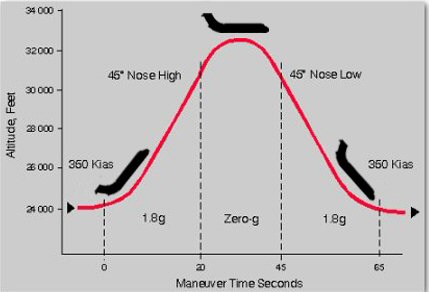
Let's quickly see how this works. The airplane flies level to the horizon at an altitude of 24,000 feet. The pilot, which in this case is not me since I am in the back of the plane, gradually increases the angle of the aircraft to about 45 degrees (nose high) to the horizon, reaching an altitude of 34,000 feet. During this particular pull-up, passengers feel the pull of 1.8 Gs, which is 1.8 times the gravity of standing on Earth at sea level. Now comes the fun part - the pilot pushes the airplane 30 - 45 degrees down (nose low). This "pushed over" creates the zero gravity segment of the parabola.

So in other words, the feeling of weightlessness is achieved by reducing the airplane's trust and lowering the nose to get a zero-lift angle of attack. It's like this roller-coaster which goes over this hump and you feel like your getting out of your seat.

Anyway, for the next 20 - 30 seconds everything in the airplane is weightless. The pilot then does a gentle pull-out and all the floaters in the airplane become slowly stable again and settle on the aircraft floor. This process is repeated several times and each time the passengers get to feel that wonderful feeling of being so light, that you float away.

This practice goes back to the late 50s. NASA's Project Mercury astronauts trained being weightless in a C-131 Samaritan aircraft - and that's where the nickname "Vomit Comet" started; all because of the nausea that is often included in doing these parabolic flights. It is believed that anxiety contributes to most passengers' airsickness. John Yaniec, a former Reduced Gravity Research Program Director, estimates that one third become violently ill, another third moderately ill and the final third is all fine. If it gets to the stage of vomiting, it is referred to as a "kill". Since 2005 NASA is using a McDonnell Douglas C-9B Skytrain II for its zero gravity training.

So, let's get this party on the road, or better, into the sky!


My morning started with a good breakfast! It's important to eat good and make sure you have all the strength.

I went to The Egg & I place - what better breakfast joint could I have found?


From there I drove to the airfield and when I arrived, I did the check-in, had to show my picture identification and then got introduced to my team. We had a Pre-Flight Orientation and there I watched a video of a Zero-G flight and got all the information I needed. I was surprised to learn that I still had to go through security. Well, they did the security screening and I again, passed with flying colors!


Once through security I was waiting for the transportation to the aircraft. So I sat back and just reviewed my last few weeks and all the great things that I had come across. I had met so many people and they all play an important role in making human space flight and space exploration possible. It's amazing! I am truly a lucky chicken and mascot.


It's time for me to take my seat, fasten my seat belt and get ready for take off. Depending on the approved airspace it can take about 30 minutes to reach the appropriate altitude. Just like in a commercial airline, you have to follow the rules. Smoking is NEVER allowed on an aircraft. Fasten your seat belt unless notified by an uniformed crew member.


This is my dear buddy Tim Bailey and NASA Test Director Shelley Baccus. They both were assigned to make sure I was fine and that I passed all the requirements. They do not feel queezy anymore - they both have experienced thousands of parabolas and they are the pros of the pros! As you can see I am currently experiencing 1.59 Gs and my well trained body is handling it without a problem.


Round 1; this is me floating. Poor Tim wasn't had a hard time to keep up with me and so the pictured turned out blurry. But that's me floating for the very first time.


After the first parabolic segment I quickly went back to my seat to make sure I was all right. I took a few deep breaths and realized that I do not need a vomit bag. So I took it home as a souvenir.


Time for my second experience of feeling weightless! This time I was doing so much better (and so did Tim with the camera). I can tell he is a pro. (and he thought to himself "I can tell that Camilla is a pro!").


After the flight Tim and I were hanging out and laughing about all the passengers who got sick. One lady really "killed"!


Watch the video of my experience - however, do not say I am "bottom-heavy!"


The official NASA picture

Tim, Shelley and I! 0.01g and it felt great! Thank you both!

Follow Tim's adventures on Twitter @tim846