Friday, November 19, 2010

Social Media - Experiences from the STS-133 NASA Tweetup

Social Media - the media for social interaction, using highly accessible, scalable and web-based publishing tools in order to turn communication into interactive dialogues. That's what it is!

#NASATweetup STS-133 (Nov 2010)

#NASATweetup STS-133 2.0 (Feb 2011)

I truly believe no other organization has utilized social media as successfully as NASA has. I was watching and reading as Mars Phoenix explored the Mars surface and I was present when our own mission SDO (Solar Dynamics Observatory) ventured into Social Media. At the time there were only a handful of NASA Twitter accounts and just a few Facebook sites discussing the amazing science behind what we do here. In fact, Little SDO started out as Little SDO HMI (HMI being one of the three instruments on SDO (the Helioseismic and Magnetic Imager - the instrument that kind of looks inside the Sun). The team quickly realized that we can really bring our mission closer to the people and get them more involved. And so Little SDO HMI became Little SDO and he convinced me to join the party and so I, Camilla SDO, got my own accounts!


But let's go back to our social media "mother" NASA. Thanks to the social media implementation, the creative ways of using the tools available, and the hard work of many people behind the scenes, NASA, via it's various missions/centers/astronauts social media accounts on Twitter, Facebook and other outlets, has been reaching a very wide variety of individuals all over the world. I am 100% positive that thanks to all of this Web 2.0+ efforts, more people have a better knowledge of Space Exploration than just 3 years ago. It's not just the die-hard fan, the one who loves sci-fi, rockets, astronomy, and everything there is to our Universe, it's now also the every day person, who can follow, learn and enjoy the discoveries, the knowledge and the plans for the future of Space Exploration! It's a new way of accessing knowledge, information, digesting and storing science, adventure and findings. And all it takes is a few minutes a day. And thanks to these Tweetups, a small army of everyday citizens got to experience a rocket launch up close! And not just the Space Shuttle - even Little SDO had a SDOisGO launch Tweet-up. The first unmanned mission to have a launch tweet-up!


In my capacity of assisting with Education and Public Outreach, I relay on social media. This is how my voice is being heard - unless you squeeze me and then you really hear me squawk. I have attended many Tweetups at various sites and I have met some really wonderful people. I have met some who hadn't really kept up with what NASA does, then attended a Tweetup, and became very interested in the subject. And I have also met people who knew NASA's history, rocket facts, astronaut information like they were a Wikipedia site! But they all walked away from these events with more knowledge, motivation, appreciation and understanding... (added on April 4, 2011: and with more inspiration!)

And I met people who thanks to a NASA Tweetup made new friends, new connections, and found new interests in life. At the latest NASA Tweetup for STS-133 at the Kennedy Space Center, I met people who housed together, who became tight and close, who will stay friends for years to come.


Here I am collecting their impressions, their words and thoughts. And no matter if you are using Social Media or not, if you are interested in NASA and Space - you should read these stories.

But one question did arise. Because we now spend more time behind a screen of some sorts, be it a computer monitor or a smart phone screen, could it be that we just get more excited about actually meeting people that are similar to us than before? Or are these new ways of meeting alikes really that powerful and life changing? You judge...

Here is a study you might want to review first:

L2, November 23, 2010

CNET News, November 23, 2010


NASA Sun-Earth Day Tweetup, March 19, 2011


Smithsonian Air and Space Museum

Chris

Aaron


NASA Ames Tweetup, February 11, 2011

Laura

Chris

Lyle

International Spacemission


NASA Tweetup STS-133, October/November 2010 
& February 2011 2.0


Raam Dev

Craft Lass

Tallulah

Joi
NASA Tweetup STS-132, May 2010

Arlo 

Beth


NASA Tweetup SDOisGO, February 2010


Aleya


NASA Tweetup STS-129, November 2009

Scott

Beth

SpaceFlight.com


Space Fair 2010 - Melaka Planetarium, Malaysia

This is my very first visit to Malaysia and it is a beautiful country. It consists of thirteen states and three federal territories and has a total landmass of 329,847 square kilometres (127,350 sq mi). The country is separated by the South China Sea into two regions, Peninsular Malaysia and Malaysian Borneo (also known as West and East Malaysia respectively).

Science Policy in Malaysia is regulated by the Ministry of Science, Technology, and Environment. Malaysia is one of the world's largest exporters of semiconductor devices, electrical goods, and information and communication technology products. In 2002 the Malaysian National Space Agency (Angkasa) was formed to deal with all of Malaysia's activities in space, and to promote space education and space experiments. In early 2006, Sheikh Muszaphar Shukor and three other finalists were selected for the Angkasawan spaceflight program.

Sheikh Muszaphar Shukor became the first Malaysian to go into Space in October 2007, making Malaysia the 37th Nation to have visited Space. He traveled on board a Soyuz TMA-11 with the Expedition 16 crew to the ISS.
Astronaut Peggy Whitson (right), Expedition 16 commander; Russia's Federal Space Agency cosmonaut Yuri Malenchenko, flight engineer and Soyuz commander; and Malaysian spaceflight participant Sheikh Muszaphar Shukor pose for a portrait following a pre-flight press conference at the Johnson Space Center. Whitson, Malenchenko and Shukor are scheduled to launch to the International Space Station in a Soyuz spacecraft in October 2007

I am telling you all of this because there are some many wonderful connections to all of this. First and foremost, Sheikh's fellow astronauts on TMA-11 were Yuri Malenchenko and Peggy Whitson. And once on board the ISS, they joined my dear friend Clay Anderson, who was then replaced later in October by Astronaut Daniel Tani, who I also got to meet very recently. As you can see, with only approx. 530 people having visited Space, you are bound to find some fun connections.
Flat Peggy & I at JSC

3D Clay & I at JSC
Astro-Blue-Color-Brothers, Dan & I at KSC

But let's go back to the reason why I am in Malaysia. I was invited by the Melaka Planetarium to attend their Melaka Space Carnival as part of NASA's Exploration & Discoveries in the new Millennium. I am part of a very impressive team, ranging from NASA HQ, JPL, and GSFC. Everybody brings something special to the table and over the next few days, we will have various activities throughout the day. For example, we will show Science Themed Exhibits and videos, show computer based simulations, show Marscape and Earthscape, have hands-on activities, lectures, workshops, video conferences and so much more. Kids, students, teachers and everybody else can come and be part of our activities at the beautiful Melaka Planetarium.


Science Themed Exhibits
We will teach about NASA's latest exploration and discoveries
- Universe; Discoveries of the New Millenium
- Sun
- Mars
- Earth and its Climate
- Natural Hazards
- Humans in Space

Hands-on Activities
- Scale Modeling of the Solar System
- UV Beads as part of UV Light/Sun
- Global Warming in Action
- Straw Rockets
- Building a Spectroscope
- View the Sun with a Solar Telescope
- Robotic Exploration
- Color Your Favorite Space Picture (for the very young ones!)

Workshop for Teachers
NASA has a wide variety of resources available for both teachers and students. Both the teacher and student websites offer numerous learning tools and are a resource for teachers.  In this Teacher Workshop the NASA Education Office will show how to navigate through the numerous amount of information to find what you need on the NASA Education website. You will explore some of the tools you can use to inspire, excite, and engage your students.  Topics of discussion include NASA’s Digital Learning Network (DLN), NASA eClips™, Podcasts, Students’ Cloud Observations Online (S’COOL), Smart Skies, and more.


Talks by NASA Professionals

Investigating the Earth’s Climate and Natural Hazards
Tom Nolan
Flight Instruments Operations Engineer
NASA’s Jet Propulsion Laboratory


The Sun and Us
Dr. GopalswamyNatchimuthuk,
Heliophysicist
NASA GSFC

Robotic Space Exploration and Next Missions to Mars
Mr. Paulo Younse
Robotics Engineer
NASA’s Jet Propulsion Laboratory

Astronomy in the New Millennium
Jaya Bajpayee
Program Executive for Operating Missions
Astrophysics Division
Science Mission Directorate
NASA HQ


Video Conferences with NASA's Jet Propulsion Lab (JPL)

Mars

“Hitting the Road on Mars: The Legacy of the 2004 Mars Exploration Rovers and the next Missions to Mars”
Nagin Cox


Robotic Planetary Exploration

“Future of U.S. Robotic Planetary Exploration”
RandiiWessen


Climate

Amber Jenkins

Tuesday, November 16, 2010

Space Weather - Lost

Last week we talked a little bit more about Space Weather and what causes Space Weather. We also started to look at some of the impact Space Weather has on our daily life. There is a growing body of evidence indicating that changes in the geomagnetic field affect biological systems. Studies indicate that physically stressed human biological systems may respond to fluctuations in the geomagnetic field. Interest and concern in this subject have led the Union of Radio Science International to create a new commission entitled Electromagnetics in Biology and Medicine.

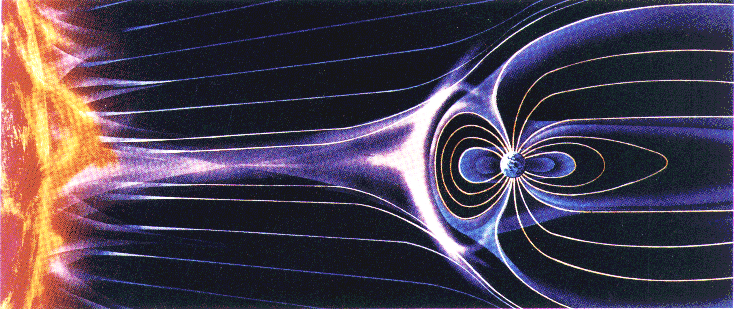
This is an artist's rendering of solar wind coming towards the Earth and its magnetosphere.
Possibly the most closely studied of the variable biological effects of the Sun has been the degradation of homing pigeons’ navigational abilities during geomagnetic storms. Pigeons and other migratory animals, such as dolphins and whales, have internal biological compasses composed of the mineral magnetite wrapped in bundles of nerve cells. While this probably is not their primarily method of navigation, there have been many pigeon race smashes during a geomagnetic storm. A smash is a term used when only a small percentage of birds return home from a release site. Because these losses have occurred during geomagnetic storms, pigeon handlers have learned to ask for geomagnetic alerts and warnings as an aid to scheduling races.

Ready, Set, Lost! 

Racing homing pigeons navigate incredible distances with apparent ease. A champion racing pigeon can be released 400 miles from its home loft, in a place it has never been before, and return within 1 day. The last 40 miles of its journey, the bird navigates by sight. But over the other 360 miles, the pigeon determines its way home by "sensing" the Earth's magnetic fields. We are not yet sure exactly how this mechanism works, but it does work -- extremely well.
Speedpigeon AU 02 LV 682 (I call him Moritz!)

How can the Sun affect racing pigeons?

When there is especially strong activity on the Sun, such as a Coronal Mass Ejection (CME), unusually strong surges of solar wind (charged particles from the Sun) can create a geomagnetic storm which distorts the Earth's normal magnetic field. The pigeons can no longer rely on their normal guidance system and may become lost. Thus wise pigeon racers, especially those in very northern areas, keep track of solar activity and do not fly their birds under certain geomagnetic conditions.


How do we measure geomagnetic activity?

Geomagnetic activity is measured by what we call the 'A' Index, which ranges from 0 to 400 Nanoteslas (nT), a measurement of the strength of a magnetic field. 0 indicates virtually no geomagnetic disturbance, while 400 is the maximum disturbance. Another useful number is the "K" index, which tracks changes in the radio atmosphere and can affect pigeon navigation. The K index ranges from zero (no disturbance) to 9 in a maximum disturbance.

24-hour Forecast: Geophysical Activity Forecast : The geomagnetic field is expected to be mostly unsettled to active with a slight chance for an isolated period of minor storming over the next 3 days (16-18 November). This activity is forecast because of elevated solar wind speeds near 650 km/s and intermittent periods of southward Bz, as well as a possible glancing blow from the CME on 13 November.

What levels of geomagnetic activity are dangerous for pigeons?

Any current reading of local figures over 150 nT in the A index of geomagnetic activity, or 4 or higher in 'K' index, is considered unsafe for training or racing pigeons.

Where can pigeon racers and fliers get solar activity data?

Geomagnetic stations track geomagnetic activity around the Earth. Their readings are freely available. The center of these activities in the USA is the Space Environment Center at Boulder, Colorado. There are other data centers in various parts of the world. Because the Earth's geomagnetic field emanates from the poles, the affects are more dramatic in the far north and far south. Thus pigeon racers need to rely on local data, that is, data that accurately represents the state of the geomagnetic field in their particular geographical location.

Monday, November 15, 2010

"Why Me?" - From France Catherine Laplace Builhe

I am aware that many of my friends know Catherine already or follow one of her many amazing streams of information. But maybe you don't know what she does for a living?! I wanted to get her introduced just to show what a variety of people follow not only me, but other Space Missions. Collectively we share information, our excitement and learn - and there is plenty for me to learn on my journey. And there are times when I go through Catherine's huge amount of information and images and get thankful for having the information on my finger (well...) tips!


Catherine is from France - and our first European person on "Why Me?". 


When you are not enjoying Social Media, what do you do as a profession? 
I am a consultant for Aerospace Tourism in Paris...I work as a freelancer.
My job is to find Russian travel agencies specializing for sale trips to the French tourists eager to get under the skin of a cosmonaut before takeoff!
Custom Travels as :


- Crew training for space tourists who get ready to participate in short-time manned missions on Russian space ships "Soyuz", and on other prospective space crafts built for implementation of space orbital or suborbital flights;

- Zero Gravity with "IL-76 MDK" wide-body airplane who is a unique flying laboratory, which can create short-term weightless conditions

- Hydrospace in the swimming pool for simulating the extra-vehicular activity conditions.

- Centrifuge with a method of semi-natural simulation of linear accelerations in the centrifuges with a mobile cab for simulation of G-loads, originating in a space flight.

- Simulators at the Yuri Gagarin Russian State Scientific-Research and Test Center of Cosmonaut Training. To acquire actual skills on a space vehicle control by means of unique hardware and facilities and learn a lot about the space vehicle's docking process. Learning also fundamentals of space navigation. 

- And of course the visit the Baikonur launch site to witness a space launch vehicle, as well as to Participate in pre-launch activities.!!! 

What has made space exploration such an interesting subject for you?
Apollo 11! when i was little girl and I saw the first images in black and white of first steps on the moon, it was a shock! I wanted to be an astronaut or fighter pilot !! ( But in France ..to be astronaut is not a job lol!) and Valentina Terechkova

In your opinion what are the 3 most amazing achievements/results of space exploration? 
The best achievements have been Hubble Space Telescope, Voyager, and all manned spaceflight.. 


Preparing for Flight...Attired in training versions of their shuttle launch and entry suits, STS-133 commander Steve Lindsey, pilot Eric Boe (background), and mission specialists Tim Kopra (right foreground) and Alvin Drew participate in a simulation exercise in the motion-base shuttle mission simulator in the Jake Garn Simulation and Training Facility at NASA's Johnson Space Center.
Image Credit: NASA/JSC James Blair
Is there a current mission (or missions) you follow regularly? If so, what mission(s)? 
I follow all space shuttle flights from launch to landing and each Soyuz launch, docking, undocking and landing. I follow also the Kepler Mission, Chandra, Mars500, LRO, SDO, Wise, Voyager, Cassini and The little Mars Rover :)) 


Why are you friends of this Not-Every-Day-Run-Of-The-Mill rubber chicken? 
I am friend with rubber chicken because I like the Sun and she has always some amazing topics about that on her wall! And she is funny!:)) 

What is your advice to today's youth? 
The same advice that John Glenn had:
“The most important thing we can do is inspire young minds and to advance the kind of science, math and technology education that will help youngsters take us to the next phase of space travel.”
John Glenn 


Twitter: www.twitter.com/WOW1977
Facebook: http://www.facebook.com/pages/Catherine-Laplace-Builhe/133447440038359

Thursday, November 11, 2010

Space Weather - Impact on Life on Earth

The other day we discussed what Space Weather is. It was very basic just to give you an idea of how it comes about. Now let's see if there is an impact of Space Weather down here on Earth. It's not like you need a special Space Weather umbrella to protect you from it - or a tin foil hat. Even though it would be great to see this on a daily basis, don't you think?


We have already established that Space Weather has an impact on not only life (or technology) in Space, but also down here on Earth. Let's take a closer look at how a Space Weather event can impact us here on Earth.

First, let's review how Space Weather impacts Earth on a global scale. Here is a short movie showing you a CME (Coronal Mass Ejection) from the Sun, traveling through Space and interacting with Earth's magnetosphere.


The most beautiful impact all of this has are the awe-inspiring Aurora Borealis and Aurora Australis -- the Northern and Southern lights.To witness these lights is a treat and I could spend hours looking at images and videos of those events. Let's take a closer look at why we see these amazing shapes in the Northern or Southern skies.

Near the poles of Earth, observers have often seen glowing clouds shaped like curtains, tapestries, snakes, or even spectacular radiating beams. Northern Hemisphere observers call them the Northern Lights of Aurora Borealis. Southern Hemisphere observers call them the Southern Lights or Aurora Australis. Because most people, and land masses, are found north of the equator, we have a longer record of observing them in northern regions such as Alaska ,Canada, Scandinavia, but sometimes as far south as the Mediterranian Sea or Mexico! 


Earth is surrounded by a magnetic field. Sprinkle iron filings on a paper and put a magnet underneath. You will see lines of magnetism that seem to 'flow' towards the poles of the magnet. If you were a charged particle in space, you would be magnetically trapped on one of these lines of magnetism. As you flow down Earth's magnetic field into the north and south poles, you collide with atoms of oxygen and nitrogen. This gives off the colored lights you see in an aurora. What do you think these ovals of light look like from the ground if you were looking up at the sky? From space we can look down at an aurora and see that it actually looks like a crown of light! Scientists call this the Auroral Oval as you can see in the picture below. If you were standing on the ground looking up at the night sky, you would only see a very small part of this halo. It would look like beautiful draperies and curtains of shimmering light that change shape from minute to minute!


On May 29, looking southward from a vantage point about 350 kilometers above the southern Indian Ocean, astronauts onboard the International Space Station watched this enormous, green ribbon shimmering below. Known as aurora australis or southern lights, the shifting, luminous bands are commonly seen at high northern latitudes as well, there known as the aurora borealis or northern lights. North or south their cause is the same though, as energetic charged particles from the magnetosphere pile into the atmosphere near the Earth's poles. To produce the characteristic greenish glow, the energetic particles excite oxygen atoms at altitudes of 100 kilometers or more. Aurora on May 29 were likely triggered by the interaction of the magnetosphere with a coronal mass ejection erupting from the Sun on May 24.


And we are not all that special here on Earth! We have been able to observe Auroras on other planets, like Saturn. What drives auroras on Saturn? To help find out, scientists have sorted through hundreds of infrared images of Saturn taken by the Cassini spacecraft for other purposes, trying to find enough aurora images to correlate changes and make movies. Once made, some movies clearly show that Saturnian auroras can change not only with the angle of the Sun, but also as the planet rotates. Furthermore, some auroral changes appear related to waves in Saturn's magnetosphere likely caused by Saturn's moons. A false-colored image taken in 2007 shows Saturn in three bands of infrared light. The rings reflect relatively blue sunlight, while the planet itself glows in comparatively low energy red. A band of southern aurora in visible in green. Inspection of many more Saturnian images may well lead to an even better understanding of both Saturn's and Earth's auroras.

But let's enjoy some more aurora pictures from right down here! Next time I will talk a little more on how Space Weather impacts us living creatures.


Wednesday, November 10, 2010

Space Weather - a different kind of Storm!

Space Weather to me is much easier to understand than weather as we know on Earth. We have so many different forms of weather down here. From sunshine to rain, snow, clouds, winds, tornados, and hurricanes. It comes in so many forms and predicting weather has become an important part of our lives. I, for one, check the weather  forecast in the morning so I know if I need to bring an umbrella or if by the end of the week, I need to expect snow or ice! So why do we want to forecast Space Weather? What's the issue and what are the benefits of predicting what's kind of "weather" is traveling from the Sun to us?

Space Weather has a few less components to it than our daily weather on our planet. There is no rain or snow. To put it very simple; it's sunshine and some magnetic fields. But its impact is very similar to weather down here. It can have a huge economical impact and it can cause casualties. That is why we would like to learn, understand and predict Space Weather better and further out. Let's start at the beginning - which in this case is on the Sun:

Sunspots on Active Region 1121, November 10, 2010

Magnetic Field Lines on November 10, 2010 - lower left is Active Region 1121
Sunspots show us where the Sun's magnetic fields are most intense. Magnetic fields above sunspots act like invisible nets, blocking the escape of electrically charged gas, or plasma, that constantly boils away from the solar surface. When the pressure is too great, they burst. Solar storms then erupt with the power of millions of Hydrogen bombs!

One of the four coronal mass ejections on 1 August 2010, as seen in extreme ultraviolet light by the Solar Dynamics Observatory. Original caption: "On August 1st, almost the entire Earth-facing side of the sun erupted in a tumult of activity. There was a C3-class solar flare, a solar tsunami, multiple filaments of magnetism lifting off the stellar surface, large-scale shaking of the solar corona, radio bursts, a coronal mass ejection and more. This extreme ultraviolet snapshot from the Solar Dynamics Observatory shows the sun's northern hemisphere in mid-eruption. Different colors in the image represent different gas temperatures ranging from ~1 to 2 million degrees K.

If the explosion occurs low in the solar atmosphere, the blast is short but intense. It pours out ultraviolet light, x-rays and energetic particle radiation - a solar flare. If the magnetic "nets" stretch far into the corona before they break, we have a Coronal Mass Ejection (CME), a billion tons of solar plasma speeding at over a million miles per hour! 

Two to four days later, if the storm is aimed at Earth, the results can be dramatic. Induced currents can corrode pipelines, destroy power grids, and cause blackouts. Navigation and communication satellites can be damaged.


Astronauts may be exposed to high radiation doses. The most beautiful effects of Earth-directed solar storms are aurora  shimmering curtains and swirls of light in the night sky. Some solar particles find their way into Earth's protective magnetosphere. Most gather on the far side in the  magnetotail. Then, sped by a magnetic slingshot, the re-energized particles zoom in along Earth's magnetic fields and strike the upper atmosphere in ovals around the poles where atoms glow like neon lights! 


So, now that we have reviewed what Space Weather is, in a very simple way, we can learn more about its impact. I will have more information for you soon! Stay tuned! 


Sunday, November 7, 2010

Why Me?" - Meet Kate from Australia...

Sorry for not posting a "Why Me?" post last week. With me having been to NASA KSC for the STS-133 launch, I was rather busy keeping up with the various launch delays/scrubs, activities and meeting some amazing people from all around the world. But back to "Why Me?" This week, I am excited to introduce you to Kate...

Kate and I have known each other for some time. What I truly admire about Kate is her knowledge of Space History, and her tribute to the fallen astronauts. Kate has a good sense of humor and even though she sometimes calls me "duck", I will visit her and enjoy her knowledge one of these days...


When you are not enjoying Social Media, what do you do as a profession?
My space achievements if they can be callled that are writing and researching articles. It was a thrill when my book "Fallen Astronauts" was published-people were in awe of what I had done. I have enjoyed meeting different scientists, astronauts, and space people becoming friends with many of them. Besides space, I enjoy biking, swimming, reading mainly non fiction-US history, politics, military history, spaceflight and GLBT literature. I am also slave to a 16 year old cat, Benedick!

What has made space exploration such an interesting subject for you?
Dad made me watch Apollo 11 at the age of six-he was a total history buff and explained everything to me. When I saw the Moon that night, I was angry that I didn't see the astronauts. 

In your opinion what are the 3 most amazing achievements/results of space exploration?
Space exploration is the best example of human ingeniuity, inspiration and excellence. Space wise-the best achievements have been the Apollo program, Voyager, Hubble Space Telescope, any planetarypexploration and human spaceflight.

Is there a current mission (or missions) you follow regularly? If so, what mission(s)?
I keep an eye on the planetary missions particularly Voyager, HST and Cassini. I also follow each space shuttle flight from launch to landing-with the supersition of not changing or washing my socks for the duration of each mission!

Why are you friends of this Not-Every-Day-Run-Of-The-Mill rubber chicken?
I follow a rubber chicken because she knows more about the Sun than most people and she has an almost Aussie approach it life. 

What is your advice to today's youth?
My thoughts to today's youth are study hard-maths and science and you could land up on Mars!

Facebook Name: www.facebook.com/Kate.Doolan 
Facebook Group: Fallen Astronauts
Twitter Name: www.twitterl.com/aussiespacekate


Apollo 1 crew talking to NAA engineers who participated in spacecraft flight simulation. Frank Borman in the background.