Thursday, March 22, 2012

A for Aeronautics

NASA's first "A" stands for Aeronautics. But what exactly does this mean and how does this impact my work? 
I feel the need. The need for speed - those little chicken wings kept us flying!
Well, I thought today would be a great day to talk about "Aeronautics". Why today? Because I just landed from my first T-38 piloting gig. For realz! But first things first. 

Aeronautics has been part of NASA for more than 50 years. Before that, the National Advisory Committee for Aeronautics conducted pioneering research that influenced the design of every U.S. aircraft. NASA integrated that knowledge and existing testing facilities when it was created in 1958. 


NASA's Aeronautics Research Mission Directorate works to solve the challenges that still exist in our nation's air transportation system;  air traffic congestions, safety and environmental impacts and geese and ducks. (sorry, couldn't resist - I love a good goose and duck joke!). 


There are actually four NASA centers conducting aeronautics research. Those four are: 
Ames Research
Dryden Flight Research
Glenn Research
and Langley Research Center 

NASA’s aeronautics activities are organized into four research programs and one test facilities management program:
• Aeronautics Test Program
• Airspace Systems Program
• Aviation Safety Program
• Fundamental Aeronautics Program
• Integrated Systems Research Program


A T-38 is silhouetted against the sun in flight. Photo courtesy of Terry Virts
Ok, enough about that. Let's talk about flying a little more. In fact, let's talk about one of the iconic NASA airplanes; the T-38 Talon. It is also called "White Rocket" because of its NASA paint scheme (largely white with a blue stripe down the length of its narrow fuselage). The 38s have two GE J85-GE-5 turbojets engines with afterburners, reaching a top speed of up to Mach 1.6, and soar above 40,000 feet, which is about 10,000 feet higher than airliners typically cruise.


The two seater can wrench its pilots through more than seven Gs, which is seven times the force of gravity. I am telling you, that is enough to make simple lifting a hand a very hard chore and makes my neck feel like it is balancing on a cinder block. Besides, the average person blacks out. Not me though. 


The T-38 was first flown by the U.S. Air Force in the early 60s as an advanced jet trainer. In fact, the U.S. Air Force still uses it in that capacity. Did you know that the Air Force Thunderbirds used it during the 1970s?


There are several NASA astronauts who learned to fly the T-38 during their time in the Air Force. Terry Virts for example, who learned to pilot this sleek plane when he was a 21-year-old lieutenant. I remember Terry saying how it doesn't pull Gs like a frontline fighter, but the 38 can do rolls amazingly well. And believe me, I had always wanted to jam the stick to the side and see the plane roll, really fast roll. Today, when I flew and did a bunch of rolls I was like "Okaydokey, that's enough rolling for now!". 


Did you ever wonder why NASA's astronauts need to fly this great airplane? Anyone who did not fly a T-38 before they got to NASA learned to fly it once they joined the astronaut corps. Basic Astronaut training includes T-38 courses, and mission specialists, who dido not sit at the controls of the space shuttle, had to record four hours a month of stick time. Commanders and pilots were required to fly 15 hours a month to keep up their proficiency.

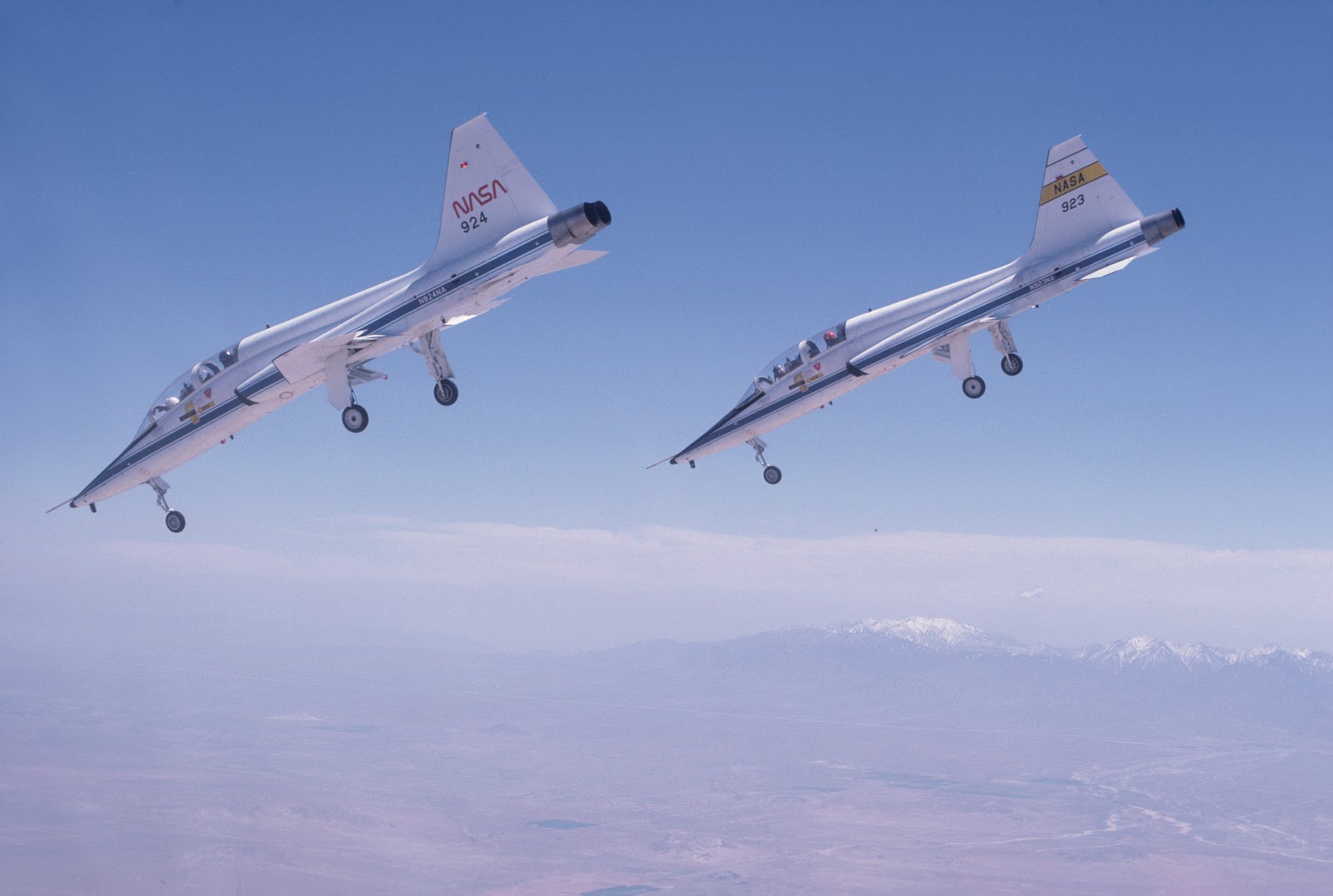
But the T-38 is also used for other aspects, like scout weather conditions during the hours before liftoff, chase other aircrafts and report about flight characteristics and yes, it also served as a training tool to simulate a Shuttle landing. So the T-38 was modified with some extra-large set of air brakes on the bottom of the plane and the astronaut pilots had to prove it could fly safely with the landing gear down and those air brakes open. With those steps in place astronauts could point the T-38s nose down at the ground and fly it toward the runway faster than 300 mph. It wasn't an exact physical simulation but flying these approaches in a T-38 showed the astronauts what a landing in the Shuttle would look like, time and time again.
A pair of T-38s dive toward a runway at Edwards Air Force Base in Calif., on a steep approach like the one the shuttle uses on approach. Photo courtesy of Story Musgrave
Furthermore, flying the T-38 also helps pilots with spacewalking. Yup! That's right. Even though mechanically there are no similarities. A spacesuit does not have a control stick and rudder pedals. However, on the mental side, a T-38 and a space suite have critical supplies that cannot be allowed to run out. That means the operator in both cases have to follow their progress carefully and make sure that they aren't using too much fuel, in case of the T-38, or running low on oxygen, in case of the spacesuit.

Anyway, this morning I had breakfast with Astronaut Reid Wiseman. Reid, an U.S. Naval Test Pilot, who has flown the F-14 Tomcat (one of my favorite birds), and the F/A-18F Super Hornet, was a very comfortable choice for me to be my instructor. I decided on some greasy food, since that helps with airsickness. So I had a piece of pizza while Reid only had a peanut butter and jelly sandwich.

Well, off we went to the airfield, boarded the plane and took off...
At first I was scared, but then I realized it was all numbers and math.

I had so much fun until I looked into the rear-view mirror...

Since we are talking about flying - do you know Space Weather has a big impact on flying too. There are several issues - as you know a solar flare's main effect is an atmospheric one. So if you are a high-frequency radio communicator in a ship at sea or flying in a place, you might not have a working high-frequenzy radio signal during those flares.

Maybe even more of an issue could be the loss of a power grid. See, when a coronal mass ejection hits the Earth, currents are being induced into our power grid. This could cause to overhead transformers and take down entire power grids. Also, during solar storms airlines avoid flying very northern routes because of the increase radiation doses. Now also include that Space Weather can have effects on satellites and the fact that navigation signals, weather maps and GPS signals could get lost. Hey, even Air Force One once lost all radio contact while flying over the pole.


Since the early 1800's, all aspects of our technology have been affected by severe solar disturbances beginning with telegraph outages during 1850-1900, radio disruptions between 1910-1960, and then during the Space Age, satellite outages and failures between 1965-2006. Ground-based electrical power systems have blacked out (Quebec, 1989) and airline flight crews have begun to worry about radiation exposure during solar flares. All of these events can be traced to the interaction of the Sun with Earth's magnetic field and its environment in space.

Well, I am now back and have recovered from my several aileron rolls with Reid. We had a good flight, a nice landing and I hope you learned a few things too. Don't stop here. I have a few good links for you below. One to a cool Air Traffic Control game and two others to learn more about Aeronautics and Solar Storms, especially if you are a teacher.

Stay tuned... I am heading to Star City Russia soon...


Sector 33 - Air Traffic Control Game App for iOS
Aeronautics Education: K-12 Students/Teachers Activities 
Solar Storms and Terrestrial Impacts: K-12 Students/Teachers Activities


Talk to you soon!
Camilla & Reid

Wednesday, February 1, 2012

Venus Transit - June 5/6 2012

On June 5, 2012, you will see the planet Venus as it moves across the face of the early morning Sun. This astronomical oddity has played a very important role over the last few centuries in giving scientists a way to understand the size of the solar system.

There have been 53 transits of Venus across the Sun between 2000 B.C and 2004 A.D. History says that Jeremiah Horrocks was the first human to ever witness a transit by Venus in 1631, but could other more ancient people have also seen it too? We will review the history a little closer over the next couple of days.

The Transit of Venus is among the rarest astronomical phenomena and won't happen again until the year 2117. 
Do you want to see this event and maybe participate in one of the organized events world-wide? Here you can either submit your event or find an event close-by.
A Brief History of the Transit of Venus; by Dr. Sten Odenwald (NASA GSFC)
As seen on the Sun, Venus is as big as a large sunspot. You could see it with the naked eye if you knew exactly when to look. But, because you cannot look directly at the sun except when it is close to the horizon, you would have only a very short time to be lucky to see it, and a reason for wanting to look at the sun on the horizon in this way at all!
The ancient Babylonians were the earliest sky observers who kept detailed records. Four transits occurred during the Babylonian Era on May 20, 1641 BC, November 20, 1520 BC, November 18, 1512 BC and May 23, 1406 BC. Could any of these be seen? Keep reading here
Get Involved Venus Transit 2012
Prepare of the event and then be part of the event. There are many ways to be and get involved. 
- Educators; here is a collection of lesson plans and "easy to do" activities. Everything from building an edible model of the Sun (and it tastes great) to learning how to make a real space weather broadcast!
- Public Outreach; you great museums, planetaria, youth clubs and amateur astronomers groups - take part in this "last in our life-time" event! Here are some Program Ideas. 
- Amateur Astronomers; you are the backbone of night and day time sky observations. You have spent countless hours behind your telescope and cameras and you have helped spread the word like nobody else. So make sure you are part of Venus Transit 2012 too. 
- Scientists; you Miss Lab Rat and you Mr. Data Cruncher can also get involved and provide various resources and help educate and inspire kids. You can visit classrooms and help teachers! Besides, you need to be out in the Sun once in a while! 
Over the next few weeks I will continue to update you about this event. Keep checking back! 


Thursday, January 26, 2012

Introduction into Aurorae

The beautiful and often eerie curtains of light in the night-time sky known as aurora have been enjoyed by people for millennia. Called the aurora borealis or “northern lights”, aurora also occur in the Southern Hemisphere and are called the aurora australis.


Picture Credit: Andy Keen, Inari Municipality, Northern Lapland, Finland. Taken on January 24, 2012
Many legends, myths and superstitions have revolved around the aurora throughout the history of mankind. The early dragon legends of China and Europe are said to have originated from the aurora. Some cultures have regarded the sighting of the aurora as a sign of royal birth; to others it suggests ghosts of the dead orthe precursor for war. The Eskimos of North America believed that if you whistled at the aurora it would sweep down and take you from the earth; by clapping your hands you could force it to retreat.

The origin of the aurora is 93 million miles (149 million km) from Earth at the Sun. Energetic particles from the Sun are carried out into space along with the ever-present hot solar wind. This wind sweeps supersonically toward Earth through interplanetary space at speeds ranging from 300 to over 1000 km per second, carrying with it the solar magnetic field. The solar wind distorts the Earth’s magnetic field to create the comet-shaped magnetosphere.


The terrestrial magnetic shield acts as a barrier, protecting the Earth from energetic particles and radiation in the hot solar wind. Most of these energetic particles are deflected around the Earth by the magnetosphere, but some get trapped. Electrons trapped in the Earth’s magnetic field are accelerated along the magnetic field toward the polar regions and then strike the atmosphere to form the aurora.

The particles, which stream down the magnetic field of the Earth, reach the neutral atmosphere in a rough circle called the auroral oval. This circle, or annulus, is centered over the magnetic pole and is around 3000 km in diameter during quiet times. The annulus grows larger when the magnetosphere is disturbed. The location of the auroral oval is generally found between 60 and 70 degrees north and south latitude.
Great education video about Aurorae
Auroral features come in many shapes and sizes. Tall arcs and rays start brightly 100 km above the Earth’s surface and extend upward along its magnetic field for hundreds of km. These arcs or curtains can be as thin as 100 meters while extending from horizon to horizon. Auroral arcs can nearly stand still and then, as though a hand has been run along a tall curtain, the aurora will begin to dance and turn. After midnight, the aurora can take on a patchy appearance and the patches often blink on and off once every 10 seconds or so until dawn.

Most of the auroral features are greenish yellow but sometimes the tall rays will turn red at their tops and along their lower edge. On rare occasions, sunlight will hit the top part of the auroral rays creating a faint blue color. On very rare occasions (once every 10 years or so) the aurora can be a deep blood red color from top to bottom. In addition to producing light, the energetic auroral particles deposit heat. The heat is dissipated by infrared radiation or transported away by strong winds in the upper atmosphere.
Image Credit: An all-red aurora captured in Independence, Mo., on October 24, 2011. Image Courtesy of Tobias Billings
The aurora is caused by the interaction of highenergy particles (usually electrons) with neutral atoms in the Earth’s upper atmosphere. These high energy particles can “excite” (by collisions) valence electrons that are bound to the neutral atom. The excited electrons can then return to their initial, lower energy state, and in the process release photons (light particles). This process is similar to the discharge in a neon lamp.

Any particular color of the aurora depends on a specific atmospheric gas and its electrical state, and on the energy of the particle that hits the atmospheric gas. Atomic oxygen is responsible for the two main colors of green (wavelength of 557.7 nm) and red (630.0 nm).


Credit: Andy Keen of Inari, Finland

Thursday, January 5, 2012

STEM or STEAM (Science, Technology, Engineering, Art&Aeronautics, Math)

My dearest friends! Can you believe it is already 2012? Happy New Year!

This year will be all about STEM or I like to call it STEAM. I really think Art and Aeronautics should be included too.

To start off I am going to collect some helpful links where parents and teachers can get good STEM activities for their kids. Check back because I will keep adding links as I come across them.


National Bird Day (Jan 5, 2012) - Many issues are affecting our birds. Teachers Pack available here.

GLOBE at Night - Student activities preparing students for star observations at night and talks about the issues surrounding light pollution. Teachers Pack available here.

I-STEM - Resource Network and Lessons Plans available here.

Tech Know Teaching - STEM Activities available here.

STEM Education Coalition - support STEM programs for teachers and students at the US Department of Education, NSF and other agencies. Website here.

STEM Activities and Resources for K-12 Teachers and Students - National Science Foundation GK-12 website here.

PBS Teacher - STEM Education Resource Center website here.

NASA Digital Learning Network - NASA DLN connects students and teachers with NASA Experts and education specialists using online communication technology. Website here.


iCreate to Educate - increases student understanding across all content areas with simple, intuitive technology. Website here.

Friday, November 18, 2011

Time Zones & Times - what it means for NASA SDO

Ever wonder why we have Eastern (or Mountain, or Pacific) Standard Time? You can thank the railroads. On November 18, 1889 railroads in the United States began using the set of "Standard" timezones that we more or less use today. 


Before the U.S. had time zones, how did people traveling across the country know what time it was? Until the invention of the railway, it took such a long time to get from one place to another, that local "sun" time could be used. When traveling to the east or to the west, a person would have to change his or her watch by one minute every 12 miles in order to always have the correct time.


When people began traveling hundreds of miles in a day by train, calculating the time became a problem. Railroad lines needed to create schedules for departures and arrivals, but every city had a different time!


Navy Yard officials set a clock to the official time in Brooklyn, New York
CREDIT: “Taking the time, Brooklyn Navy Yard,” 1890-1901. Prints and Photographs Division, Library of Congress. Reproduction Number LC-D4-21274 A.
At first the railroad managers tried to address the problem by establishing 100 different railroad time zones. With so many time zones, different railroad lines were sometimes on different time systems, and scheduling remained confusing and uncertain.

Finally, the railway managers agreed to use four time zones for the continental United States: Eastern, Central, Mountain, and Pacific. Local times would no longer be used by the railroads. The U.S. Naval Observatory, responsible for establishing the official time in the United States, agreed to make the change. At 12 noon on November 18, 1883, the U.S. Naval Observatory began signaling the change. 


As Greenwich Mean Time (the official time used by the U. S. Naval Observatory) was transmitted by telegraph, authorities in major cities and managers of the railroads reset their clocks. All over the United States and Canada, people changed their clocks and watches to match the time for the zone they lived in. Quickly, the confusion caused by the many different standards of time was resolved.


This 1892 train map shows the route of the Burlington &. Quincy Railroad and the new time zones
CREDIT: Rand McNally and Company. “Burlington Route,” 1892. Geography and Map Division, Library of Congress. Call Number G3701.P3 1892 .R3 RR 357.
The color blobs in this figure on the very top show the timezones used today around the world. Before standard time each community kept track of time. Some important times (such as noon) where announced by ringing bells or another signal. Imagine a train arriving in one town before it left the last one! Not everyone was happy and some towns continued to use local solar time until 1918.

Today we release SDO marked in Coordinated Universal Time (diplomatically called UTC) and International Atomic Time (similarly, TAI). TAI is the number of seconds since midnite January 1, 1958. A series of laboratories keep track of the march of time. UTC maps TAI to almost local solar time at the Greenwich Meridian in England (the line where longitude is 0). This means that UTC has leap seconds to keep up with the slowing down of the Earth's rotation. Right now we have added 34 leap seconds to UTC. We like TAI because it is easy to do differences in time by subtracting the TAI times. This is not true for UTC.

When you look an SDO timestamp it will say Z or UTC if the time is UTC; T or TAI when it is TAI.


Today's Sun in 304 angstrom - is shows the ~50,000 degrees C. Chromosphere

Tuesday, November 8, 2011

Sunspots

This week we have been seeing the largest sunspot/active region in years. In fact, the entire group is larger than Jupiter. So let's take a look at the history of Sunspots and also see how big this sunspot group labeled AR1339 (for Active Region) really is. 


This image is from November 7, 2011 and it shows the large active region 1339. On the lower right corner you have a size comparison between Earth, Jupiter and the AR 1339

This is AR1339 again on November 8, 2011. Look at this amazing image! 
What were sunspots? Galileo had guessed they were clouds floating in the Sun's atmosphere, obscuring some of its light. Their true nature only emerged in 1908 when George Elery Hale, leader among US astronomers, showed that they were intensely magnetic. Their magnetic field was as strong as that of a small iron magnet, some 3000 times stronger than the field near the surface of the Earth--yet those fields often extended over areas larger than the entire surface of the Earth. Apparently the magnetic field somehow slowed down the flow of heat from the Sun's interior, causing the sunspots to be slightly darker than the rest of the Sun.

Beyond Galileo's Telescope
The evidence for sunspot magnetism was their emitted light. Glowing gases emit light in narrowly defined wavelengths (i.e. colors), a different set for each substance. In 1897, however, Pieter Zeeman found that when such light was emitted from the region of a strong magnetic field, the emission split into slightly different wavelengths, with a separation that increased with the strength of the field. The colors of the light emitted from sunspots were "split up" in just this way.

The method was later improved by Babcock and others, allowing astronomers to observe not only the magnetic field of sunspots but also the weak fields near the Sun's poles. It turned out that the Sun has a polar field somewhat like the Earth's, but that it reverses its polarity during each 11-year cycle.

Sunspots have also led us to a better understanding of the Earth's own magnetic field. The face of the Sun consists of ionized hot gas ("plasma"), hot enough to conduct electricity. Sunspot fields were evidently produced by electric currents, and it was well known that such currents could be generated by a "dynamo process," by the motion of an electric conductor (e.g. the flow of solar plasma) through a magnetic field.

In 1919 Sir Joseph Larmor proposed that the fields of sunspots were due to such dynamo currents. He suggested that a closed chain of cause-and-effect existed, in which the field created by these currents was also the field which made them possible, the field in which the plasma's motion generated the required currents. Many features of sunspots remain a mystery, but Larmor's idea opened an era of new understanding of magnetic processes in the Earth's core.

Sunspots are caused by the uneven rotation of the Sun, the equator rotating faster than the polar regions. That stretches out magnetic field lines, crowding them together and making their magnetic field stronger. Strong magnetic field (under the surface) pushes away the solar gas, which therefore gets less dense, so that regions of strong field tend to float up to the top, the way oil floats to the surface of water. Where it breaks the surface, sunspots occur. 

The solar surface and interior rotation rate, where red regions represent areas of slightly faster than average rotation while areas in blue show slower rotational rates. Credit: NSO
But we still do not understand a lot--why exactly the Sun rotates unevenly, why the north-south magnetic polarity reverses every 11-year cycle, how sunspots slow down the flow of solar heat (which makes them dark). 


Credit: NASA SDO / GSFC & NSO

Tuesday, October 18, 2011

The Simplicity of The Sun

Last night I was at grocery store waiting in line to pay for my sweets. A little boy in front of me looked at me with big blue eyes and asked "Who are you?" - "I am Camilla. And I teach about the Sun", I replied. "Do you know what the Sun is made of?", I continued. He looked at his mom then at me and said "Fire!". 
I love the simplicity kids have in their young age. Later on in life we introduce them to an increased complex world and sometimes even make it over-complex. I thought today I would talk a little bit about what the Sun looks like inside and if there really is a big fire in there. 


I am going to keep it very simple. 


1. Core
The Sun has a Core. That is the center layer of the Sun and it is where all the Sun's heat and light is made.

2. Radiative Zone
The heat and light move from the core into this next layer. 


3. Convection Zone
In this layer the gases move pretty much like boiling water. This moves them from the inner parts of the Sun to the outer part of the Sun that we see. 


4. Photosphere
This is actually the part of the Sun we can see. This layer gives off the heat and light from the Sun. Cooler parts of this layer make sunspots; those big dark areas. 


5. Chromosphere
This is the fun layer - it shoots out hot gases. 


6. Corona
This layer is like the far, far away uncle we only get to see on special occasions. The Corona can be seen during an eclipse and is the atmosphere around the Sun. 


Can all of it be this simple? Unfortunately no. I'll give you a very complex example. 


Sunlight is produced through nuclear reactions in the sun's core. Originally born as energetic gamma rays, after billions of collisions with matter, this radiation reaches the surface and escapes into space. How old is sunlight by the time it reaches the surface?
Most textbooks say that it takes light between 100,000 years and 50 million years to escape. You would be surprised to know that this simple, and very popular, question seems to be without a firm answer! The reason has a lot to do with the assumptions that textbook authors use in making the calculation. Most astronomers are also not particularly interested in a high-accuracy answer, so they tend not to bother doing the tedious calculation exactly. It is actually a very complex problem in physics!
Once a photon of light is born, it travels at a speed of 300,000 km/sec until it collides with a charged particle and is diverted in another direction. Because the density of the sun decreases by tens of thousands of times from its lead-dense core to its tenuous photosphere, the typical distance a photon can travel between charged particles changes from 0.01 cm at the core to 0.3 cm near the surface. As a comparison, most back-of-the-envelope estimates assume that the sun's interior has a constant density and that the 'free path' distance for the photon is about one centimeter. It is these estimates that find their way into many popular astronomy textbooks.
Light escapes the sun's core through a series of random steps as it is absorbed and emitted by atoms along the way
(Courtesy - Richard Pogge Ohio State U.)
Once you know, or assume, a typical distance between collisions, you also have to figure out how many steps the photon has to take to travel from the core to the surface. This is called the Random Walk Problem. The answer is that, if you take a sequence of N random steps, each for example of one meter length, the distance you travel from the starting point will be the square-root of N. After 100 random steps you will travel about 10 meters, but it will take 10,000 steps to travel 100 meters, and one million steps to travel about one kilometer, and so on. Because the density of the sun changes from the core to the surface, it is common to represent the interior of the sun as a collection of nested shells of matter, each with a typical average density. You then calculate how many steps it takes for a photon to travel through each shell. During each step, the photon travels at the speed of light so you can calculate the time required for each step. By multiplying this by the number of steps taken, you can calculate how long it takes the photon to traverse each shell, and then add up all the times for the other shells.
When this random walk process is applied to the interior of the sun, and an accurate model of the solar interior is used, most answers for the age of sunlight come out to be between 10,000 and 170,000 years. Rarely do you get answers greater than a million years unless you have made a serious error! Why do you still see these erroneous estimates of '10 million years' still being used? Because textbook authors and editors do not bother to actually make the correct calculation themselves, and rely on older published answers from similar textbooks.
So, sometimes a simple question can have many inaccurate textbook answers because it is not considered a very important question to scientists, and no one bothers to take the time to really work out the answer to their best ability! As another example, in 1971, the physicists Alfred Goldhaber and Michael Nieto at the Los Alamos Laboratory estimated the maximum mass of the hypothetical graviton particle - the carrier of the force of gravity. Their answer of 10-62 grams seemed incredibly insignificant. Over a decade later they published an improved version of his original paper. They noted that they had originally made an error in their 1971 paper, so that the calculated mass was actually over a billion times larger. In all that time, no one had ever caught the published error!