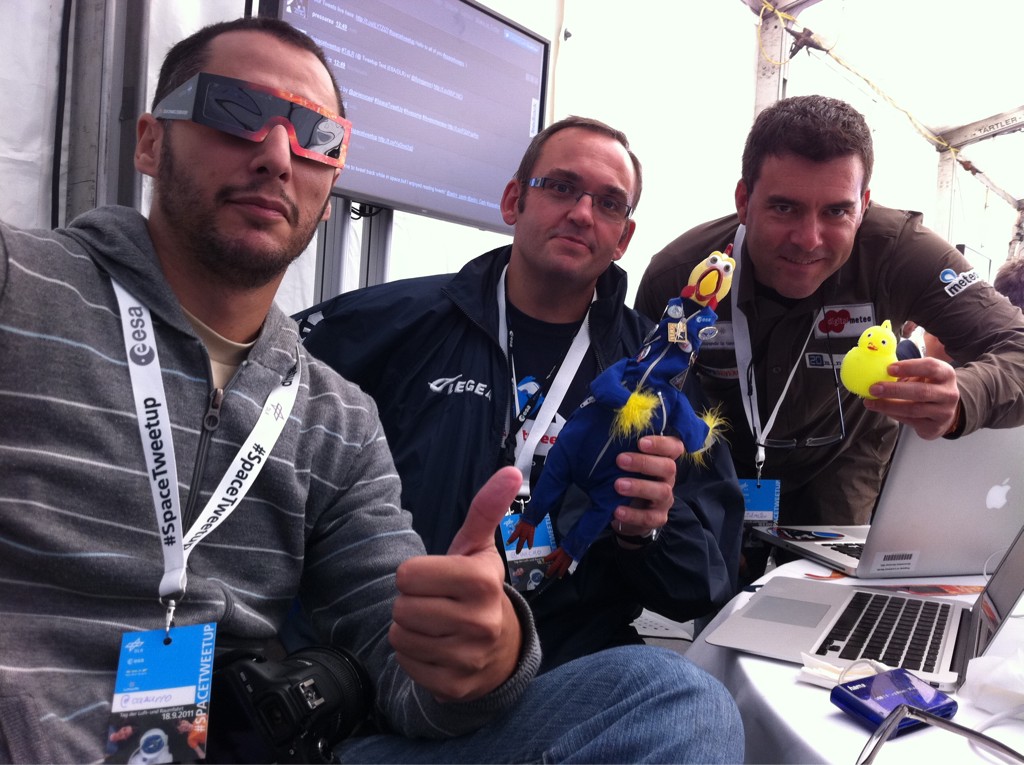
Tuesday, October 18, 2011

The Simplicity of The Sun

Last night I was at grocery store waiting in line to pay for my sweets. A little boy in front of me looked at me with big blue eyes and asked "Who are you?" - "I am Camilla. And I teach about the Sun", I replied. "Do you know what the Sun is made of?", I continued. He looked at his mom then at me and said "Fire!". 
I love the simplicity kids have in their young age. Later on in life we introduce them to an increased complex world and sometimes even make it over-complex. I thought today I would talk a little bit about what the Sun looks like inside and if there really is a big fire in there. 


I am going to keep it very simple. 


1. Core
The Sun has a Core. That is the center layer of the Sun and it is where all the Sun's heat and light is made.

2. Radiative Zone
The heat and light move from the core into this next layer. 


3. Convection Zone
In this layer the gases move pretty much like boiling water. This moves them from the inner parts of the Sun to the outer part of the Sun that we see. 


4. Photosphere
This is actually the part of the Sun we can see. This layer gives off the heat and light from the Sun. Cooler parts of this layer make sunspots; those big dark areas. 


5. Chromosphere
This is the fun layer - it shoots out hot gases. 


6. Corona
This layer is like the far, far away uncle we only get to see on special occasions. The Corona can be seen during an eclipse and is the atmosphere around the Sun. 


Can all of it be this simple? Unfortunately no. I'll give you a very complex example. 


Sunlight is produced through nuclear reactions in the sun's core. Originally born as energetic gamma rays, after billions of collisions with matter, this radiation reaches the surface and escapes into space. How old is sunlight by the time it reaches the surface?
Most textbooks say that it takes light between 100,000 years and 50 million years to escape. You would be surprised to know that this simple, and very popular, question seems to be without a firm answer! The reason has a lot to do with the assumptions that textbook authors use in making the calculation. Most astronomers are also not particularly interested in a high-accuracy answer, so they tend not to bother doing the tedious calculation exactly. It is actually a very complex problem in physics!
Once a photon of light is born, it travels at a speed of 300,000 km/sec until it collides with a charged particle and is diverted in another direction. Because the density of the sun decreases by tens of thousands of times from its lead-dense core to its tenuous photosphere, the typical distance a photon can travel between charged particles changes from 0.01 cm at the core to 0.3 cm near the surface. As a comparison, most back-of-the-envelope estimates assume that the sun's interior has a constant density and that the 'free path' distance for the photon is about one centimeter. It is these estimates that find their way into many popular astronomy textbooks.
Light escapes the sun's core through a series of random steps as it is absorbed and emitted by atoms along the way
(Courtesy - Richard Pogge Ohio State U.)
Once you know, or assume, a typical distance between collisions, you also have to figure out how many steps the photon has to take to travel from the core to the surface. This is called the Random Walk Problem. The answer is that, if you take a sequence of N random steps, each for example of one meter length, the distance you travel from the starting point will be the square-root of N. After 100 random steps you will travel about 10 meters, but it will take 10,000 steps to travel 100 meters, and one million steps to travel about one kilometer, and so on. Because the density of the sun changes from the core to the surface, it is common to represent the interior of the sun as a collection of nested shells of matter, each with a typical average density. You then calculate how many steps it takes for a photon to travel through each shell. During each step, the photon travels at the speed of light so you can calculate the time required for each step. By multiplying this by the number of steps taken, you can calculate how long it takes the photon to traverse each shell, and then add up all the times for the other shells.
When this random walk process is applied to the interior of the sun, and an accurate model of the solar interior is used, most answers for the age of sunlight come out to be between 10,000 and 170,000 years. Rarely do you get answers greater than a million years unless you have made a serious error! Why do you still see these erroneous estimates of '10 million years' still being used? Because textbook authors and editors do not bother to actually make the correct calculation themselves, and rely on older published answers from similar textbooks.
So, sometimes a simple question can have many inaccurate textbook answers because it is not considered a very important question to scientists, and no one bothers to take the time to really work out the answer to their best ability! As another example, in 1971, the physicists Alfred Goldhaber and Michael Nieto at the Los Alamos Laboratory estimated the maximum mass of the hypothetical graviton particle - the carrier of the force of gravity. Their answer of 10-62 grams seemed incredibly insignificant. Over a decade later they published an improved version of his original paper. They noted that they had originally made an error in their 1971 paper, so that the calculated mass was actually over a billion times larger. In all that time, no one had ever caught the published error!


Monday, September 19, 2011

What did THEY think?

It's the day after the 1st joint ESA and DLR Tweetup in Cologne. Many of the 60 invited tweeps are already home or on their way home. Same is true for me. After visiting the Dom of Cologne and making my way the 500+ steps up, I am about to head back to the United States. I must be in Long Beach, CA for Space2011 / AIAA Education Alley next week. (keep your eyes open for some interesting stuff - the STS-135 crew will come and visit and I will be having a presentation about our BTS-1 flight, the Sun and Space Weather).

Anyway, before I go on even more... It is time to reflect back. I want to share some of the blogs and pictures that have already been posted by others. There is really only one thing that I can say right now:

Dear ESA & DLR Team Members - you put together a very fun, interactive and impressive event. Everybody there was helpful and welcoming. It was fantastic to meet people from so many different countries, with many different languages and dialects, different views, ideas and opinions. But we all shared a common interest and love: Space & Space Exploration. There is a lot of work that goes into the preparations and execution of such an event. Thank you for doing all that, for opening up your world to us. Thanks for making us part of the team, sharing your passion, excitement and work. Thanks for letting us peak behind the curtains and see what is happening there in Cologne. And thank you for introducing your European Bluesuits to us Americans (and everybody else).

Dear Tweetup Attendees - thank you for being such cool peeps! Not only did so many of you pose with me, hold me, or tape me to a stick, but you have been sharing your stories, excitement and inspiration of ESA, DLR and many missions.

But I must also ask you to not stop there! You now have gotten an inside look of the wonderful things that are being done, the science that comes out of it and the impact it has today and in the future. Now you must take this knowledge, excitement and interest to the next level and share it with others in your circles. You have an opportunity to spread the understanding of "Why are we wanting to explore what's out there?". You have the ability to inspire the next generation of scientists, engineers, and explorers. It's easy to do, really. Continue to follow ESA, DLR, NASA, the Canadian, UK, Australian Space Agencies, ROSCOSMOS etc. and their missions. Learn what they all do, the missions they have, the science that comes out from them, and then share your knowledge with others.

Believe me, together we have the power and ability to make a big impact. W can demonstrate that science is not intimidating, that it is fun, interesting and necessary.

Zum Schluss moechte ich mich wirklich ganz herzlich bei Euch allen bedanken. Es kommt nicht oft vor, dass ein Gummihuhn so viele tolle Leute trifft und mit so vielen lustigen Erinnerung nach Hause kommen darf. Ganz vielen lieben Dank.

So here are some blogs and pictures from some people. I'll try to collect more.

AWESOME! 
Till soon!
Yours truly,

Camilla Corona SDO


ESA SpaceTweetup Blog
SpaceTweetup


Space Tweetup Wiki
18 September 2011 Space Tweetup, Cologne, Germany by DLR and ESA


Beth Beck
SpaceTweetup Awesome 


Austrian Space Forum
First European #spacetweup in Cologne

SpaceWebLog
An incredibly #awesome #SpaceTweetup


SciLogs
In der Forschung tweepts wohl


Nachrichten aus Absurdistan (which is pretty much where I live!)
Spacetweetup - when dreams come true


Space Quotes / Souvenirs d'Espace
Interview with Astronaut Alexander Gerst (ESA)

Skyweek two point Zero
Live blog form the first Euro-Space Tweetup


Birgitte Bailleul 
Observer La Terre Depuis Lespace

Virginie Courbin
When in Cologne...


Camilla Corona SDO's Blog
ESA & DLR German Aerospace Day


ESA Best of Pics
SpaceTweetup2011's Pics
SimSullen's Pics
MF72's Pics
Craftlass' Pics
Stefan M.'s Pics
Zebramaedchen's Pics
Timmermansr's Pics
Daniel Ziegenberg's Pics
Famille Sebile's Pics
Anne Grudzien's Pics
Hell yea, it's rocket science's Pics
Anatomiz's Pics
Official Group Photo


In the NEWS
XtraNews - Spacetweetup; Wie Twitter das Marketing Revolutioniert


SciLogs KosmoLogs - Impressionen vom Tag der Luf- und Raumfahrt


Raumfahrer.net - SpaceTweetup; Was machen die Space Tweeps? (Podcast)

ZDF - Hyperland Darueber Spricht das Web - Tweets im Weltall


Rhein-Zeitung - Wie twittert man im All?


More from Today's Outing to the top of the Cologne Cathedral 


Sunday, September 18, 2011

ESA & DLR German Aerospace Day - September 18, 2011

And here we are at the European Space Agency's Astronaut Center in Cologne. They have a fantastic tent for all the Tweetup SpaceTweeps, including tables, power outlets and WiFi. And everybody is extremely welcoming.

Throughout the day I will be updating this blog here. So check back for more pictures and information. I will just add them to the bottom each time I make an update. This way I keep some sort of "time-line".

Let's get started.

Had to get up early and take the train. Morning gang! 

Then it was time to take the cool bus! I am always on the cool bus. 

The European Astronaut Center (EAC) was established in 1990 and is located here in Cologne. After its foundation in 1990, three ESA astronauts were based at EAC. They were selected in 1978 for the first Spacelab mission on the Space Shuttle in 1983. ESA Astronaut Ulf Merbold (Germany) flew on that mission. Wubbo Ockels (Netherlands) flew on Spacelab D1 mission 1985. Claude Nicollier (Switzerland) completed his first mission on Space Shuttle STS-46 in 1992. Nicollier participated in three further Shuttle missions in 1993 (STS-61), 1996 (STS-75) and in 1999 (STS-103). He also become the first European to perform an Extra Vehicular Activity (EVA - or spacewalk) during a Shuttle mission. 

 My friends from @ESA, @DLR_de and @DLR_en


The one and only Stephanie Schierholz with NASA HQ

 And my new friend from @HollandSpaceCen

And this is another new friend @nhaima from Rome. 

 Totally excited to see Erin Smith from NASA Ames

Here is Little SOFIA

One of SOFIA's pilots Manny Antimisiaris.  

There she is! Hello SOFIA - first time outside of California for us! SOFIA is a world-class airborne observatory that complements the Hubble, Spitzer, Herschel and the James Webb space telescope. It features a German-built 100 inch diameter far-infrared telescope in the rear fuselage of a highly modified Boeing 747SP aircraft. 

Please meet @cpamoa from Saint-Quentin-en-Yvelines

Is this really our first picture together, @herrea?

 Inside of SOFIA now. You can see the telescope back there. 


 I even got to pose with my buddy @rocketman528 again! 
And another new friend Carlo @cazurro. He is from Granada in Spain. 

Now I am inside the huge Airbus A380. 

 More new friends! @wicho and @digitalmeteo with Polloparty! I think they are all from Spain. 

Don't get too close to those engines! 

Ok, we are heading back to the Tweetup Tent. I am leading the way... I hope there are no lightning strikes happening right now! 


This is Peter from the Netherlands @pclissold

Time for some presentations. First up SOFIA's Aloise Himmes, the Principal Investigator for the DLR part of the SOFIA mission. 

I see familiar faces... @rocketman528, @craftlass, @herrea 
US Astronaut Cady Coleman and ESA Astronaut Paolo Nespoli


Cady and I always make faces together. It's our thing! 

 I met Paolo for the first time in Baltimore in August. Good guy!

The @researcheurope representative 

 Virginie from France and Olivia. 

This is Olivia with the Austrian Space Forum. So toll! 

Maria and Olivia - they gave me the Oesterreichisches Weltraum Forum pin. Thank you! 

My Spanish friends with Little SDO solar viewing glasses. @cazurro, @wichoy 

Oh, finally! My good friend Katrin from Germany! 

Time for some group pictures. Can you spot me?

Right here - they are all pointing at me! 

And here is the large and official version of "Where is Camilla?"


Look at this group plus the STS-134 crew! 

Spanky (Astronaut Fincke) meeting my friend Eico. 


STS-134 Mission Specialist "Spanky" Michael Finke

STS-134 Pilot Gregory Johnson and Andreea from Belgium. 

STS-134 Mission Specialist 4 Gregory Chamitoff and Rin from Germany

STS-134 Mission Specialist Andrew J. Feustel

Hello Remco - nice to finally meet you! 

The truly admirable Beth Beck (sitting), Astro_Cady, Jeff and @researcheurope

ESA Astronaut & Head of the Astronaut Division at ESA, Michel Tognini (Mir-1 and STS-93 deploy emend of the Chandra X-Ray Observatory)

Hello Brigitte from France! 

ESA Astronaut Samantha Cristoforet  - she is an Italian Air Force Officer. 

A photograph of Earth 

The truly wonderful people at ESA & ESAoperations; Erica and Daniel

ESA Astronaut (also Italian) Luca Parmitano - training for ISS Exp 36. 

Kate and Astro_Luca inside the Columbia module. 

More great people! Katharina from Germany and @ESA_Italia

Me floating in the Cupola - brought to the ISS by the awesome STS-130 crew! Go Flyboy!