Sunday, January 30, 2011

NASA & Ice Hockey

While in Michigan Fuzz and I had to visit an ice rink. While I am not the biggest Detroit Red Wings fan, I am one big hockey chick! (my team are the San Jose Sharks!). 

So, Fuzz and I put on some hockey gear and some ice skates. Once on the ice we just had a lot of fun. "How does this tie back to NASA?" you might ask. Well, besides the fact that a lot of NASA employees play hockey, there are many other ties. Here are just three examples:


Since its dawning days, NASA has been at the forefront of developing and improving materials for aerospace applications. In particular, NASA requires dramatic advancements in material properties to enhance the performance, robustness, and reliability of its launch vehicles, spacecraft, and the International Space Station. Such advancements over the years include noise-abatement materials, fire-resistant fibers, heat-absorbing insulation, and light-but-strong mold- able composites.  

In 1991, a new carbon fiber called a carbon nanotube was discovered and fully substantiated by a Japanese electron microscopist. Its dramatic strength and low density (20 times the tensile strength and one-sixth the density of steel) were turning the heads of materials scientists and engineers all around the world, including those who developed equipment for NASA. After more research and testing a partnership with Zyvex Corporation developed a carbon nanotube-enhanced composite and later developed the revolutionary Easton Synergy SL composite hockey stick. It increases stick strength while reducing weight. It is lighter (420 grams) and stronger than its predecessor, and has a new blade design that yields unmatched performance.
The manipulation of materials on a molecular scale is leading to lighter-but-stronger hockey sticks. Pictured here is Easton Sports, Inc.’s Synergy SL product, featuring Zyvex Corporation’s NanoSolve technology.

In 2006 technology developed for NASA by Henry Ford Hospital helped determine whether a member of the U.S. Women’s Olympic Hockey team stays on the ice or heads for a hospital. Dr. Dulchavsky is principle investigator and team leader of a group of NASA scientists refining techniques for examining and treating sick or injured astronauts on the International Space Station. His team developed a training program that, in just a few hours, teaches non-medical crew members how to use portable ultrasound equipment to help diagnose an injury. The ultrasound images are transmitted by satellite to radiologists at Henry Ford, who read them and make a diagnosis.

The procedure got a test run with the Detroit Red Wings in 2004. Team trainers were taught how to use the ultrasound device using the NASA training methods. A portable ultrasound device was placed in the team’s locker room and was connected through the Internet to a computer at Henry Ford. While viewing the images online at the hospital, a radiologist guided the trainers as they performed ultrasound tests on players. When a player was injured during a game, a quick diagnosis could be made in the locker room.

Jay Feaster, general manager of the National Hockey League's 2004 Champion Tampa Bay Lightning, stands next to the Stanley Cup, which he brought to KSC while on a tour. The cup sits next to the orbiter Discovery in the Orbiter Processing Facility. The cup was also available for viewing by employees in the KSC Training Auditorium.
And even Lord Stanley, the royal trophy of the National Hockey League has visited NASA. In 2004, when Tampa Bay Lightning won the Playoffs, the Lord Stanley was brought to KSC, the Kennedy Space Center. At the time Lady Discovery was in the Orbiter Processing Facility and Lord Stanley was placed next to Discovery. The more than 100 year old trophy, which weights 35 lbs, looked as glamourous as the space vehicle
The Stanley Cup weighs 35 pounds and is more than 100 years old.
Always wear protective gear!

Fuzz getting his skates on!

Team spirit!

Saturday, January 29, 2011

Space Medicine - Why it's important! **not for the skirmish**

I got an invitation to the opening of the brand new science complex at the Eastern Michigan University last week. A beautiful building with a fantastic new Planetarium in it as well. The building truly boosts new technology in its labs and classrooms and is the home of the departments of Geography and Geology, Psychology, Physics and Astronomy, Biology and Chemistry.


The next day Fuzz, my Pilot and Mission Specialist on our BTS-1 Mission to the Edge of Space, and I were invited to visit a hospital in Detroit. We wanted to get a more behind the scene look and learn various aspects of laboratories within a hospital. We spent time with the Lab Techs, who are truly Medical Technologists. They are highly trained technical professionals with a 4 year degree and their work is usually the first piece of the puzzle in helping a physician diagnosis a patient's condition.

Now why is this important when it comes to Space Travel? Let's take a look:

Space exploration places great physiological and behavioral demands on crew members. Humans involved in space flight must remain healthy in hostile environments and perform a myriad of tasks essential to successfully enabling human exploration missions. Furthermore, when space explorers return to Earth they must be capable of healthy and productive lives.

Space Life Sciences is one area at NASA were they develop, provide, and sustain the medical, environmental, and scientific resources that will enable NASA's capability to pursue human space exploration. This organization within NASA supports so many areas of life science. Here are just a few examples to demonstrate the wide range of areas of science they are studying:

- Acoustics and Noise Control Lab ensures safe, healthy and habitable vehicle acoustic environments in which crews can live, communicate and work.

-Then there is the Animal Care Facility, which takes care and houses for animals used in ground-based life sciences experiments and in training astronauts for in-flight animal experiments.

- Or the Space Radiation Analysis Group, Space Radiation Dosimetry Lab, which supports the human exploration of space within acceptable levels of risk from space radiation.


- The Anthropometry and Biomechanics Facility plays a vital role in ensuring that crew selection is matched well with the design and verification of the space suits, hardware, and vehicle, while also accounting for the full range of accommodation, fit, access, and performance.

- Human Research Program Advanced Food Technology Project is responsible for providing the crews with a food system that will enable safe, reliable, and productive human space exploration.

- EVA Physiology, Systems, and Performance studies how future missions beyond low Earth orbit will present new challenges to crew health, safety, and performance. Among those challenges, crew members will likely need to perform multiple extravehicular activities (EVAs) per week to conduct mission-critical exploration, science, construction, repair and maintenance tasks.

- Bone Laboratory provides comprehensive bone, muscle, and body composition testing and evaluation.

- Tissue Analogues Laboratory provides NASA with 3D tissue analogue capabilities and the testing of normal and neoplastic human and animal tissues subjected to a variety of biological, physical and environmental stressors. This includes dusts, viruses and bacterial infections and more.

- Medical Operations Branch is responsible for providing medical support for all Shuttle and ISS missions.

- Medical Informatics & Health Care Systems Branch is focused on improving on-orbit clinical capabilities.

As you can see these are just a few areas that fall within NASA's Life Science Organization and is an important part of making and maintaining space exploration.

NASA has conducted research on blood in space for many decades. It was learned that the red blood cells effectively carry oxygen while in space. Studies have also been conducted on the white blood cells, especially how they react to space outside of the body in zero gravity and if they became "disoriented" and lost their ability to provide their immune function over time. Which would have meant that astronauts were very susceptible to infections. The question about platelets (their jobs is to ride around in your blood stream looking for any kind of break or injury where they can patch up and prevent bleeding) had to be figured out too... would they perhaps get confused in zero gravity and loose their function?
Mission X is an international educational challenge, focusing on fitness and nutrition, that teaches students how to "train like an astronaut."http://trainlikeanastronaut.org/

STS-40 Payload Specialist Drew Gaffney
performing a blood draw on Payload Specialist
 Millie Hughes-Fulford. Mission Specialist Jim Bagian
 also appearing in this picture.
As we I have talked about in some previous posts - Astronauts on the ISS draw their own blood and do tests and experiments right on the Space Station. So it was truly a good time for Fuzz and I to visit some of the labs here at this hospital.

And I will continue to visit various places and learn about Space Life Science. Stay tuned.


.

After looking at the blood a little, Fuzz and Camilla were then introduced to more people as they came back from lunch: This is Luca Visentin, he's one of the lab techs.
We got to meet Dr. Michelle Bonnett who is an Anatomic and Clinical Pathologist - if you are really sick, your specimens may go to her for further examination to determine the type of illness one may have, such as a form of cancer.
And we ran into Dr. Daniel Snower, who like Dr. Bonnett also is an Anatomic and Clinical Pathologist but he also specializes in Pediatric Pathology so he gets really special cases sometimes. He was working in frozens today and he was really busy. Since he likes Space Exploration he just had to say hi to us


Fuzz was curious how the smears were made, when looking under the microscope he noted that the blood smeared on the plate was A LOT less than what was in the tube so the introduced him to some of the chemicals and tools made for making the smears; in the background, all the multi-colored pipettes are various size micro-liters and milliliters in size.
Inside the Histology Lab, which is were tissue slides are prepped and examined, we got to look at a lung. Usually lungs are nice pink, healthy color but this long obviously was not very healthy. This is what a lung looks like after years of smoking. 
Fuzz decided he wanted to take a closer look at these machines... they would also dye some of the tissue here as well.
Our slides were done! Time to check out our work and determine a diagnosis! The lab had nifty training microscopes where we both could look at their work at the same time!


Thursday, January 20, 2011

Why Pluto was killed... and did he really have it coming?

I was fortunate enough to attend Professor Michael Brown's lecture about the demotion of Pluto. Now, I am not going to spill all the beans here. Because I want to encourage you to try and see Mike's lecture or read his book "How I Killed Pluto and Why It Had It Coming". But I will give you some of my thoughts on this subject, having heard and learned a lot about the background of this first hand.


Mike, who is a Professor of Astronomy at CalTech (California Institute of Technology), didn't actually "kill" Pluto or even attend that crazy International Astronomical Union Meeting in Prague in 2006 where astronomers with red heads were debating about what to do with this little guy and very last in line! However, he is responsible and takes the blame with pride, that all these astronomers actually debated the subject of Pluto and its planet status. So what happened?

To make a long story short (because you've got to see his lecture! It is entertaining, it is fascinating and it makes sense... which by definition is an oxymoron when it comes to astronomy!). There is a bet (well, more than one) involved between Mike and one of his good friends about him discovering a 10th planet, further out than Pluto. And all of that within the next 5 years! Fast forward 5 years and 5 days - Mike did discover something "big" moving way out there in our solar system. It was bright, it was pretty fast, it was amazing. Could this be the 10th planet of our solar system? Did he just discover what no man or woman had seen before? Well, yes and no. Turns out, that body is more or less the size of Pluto. Which in comparison is half the size of our moon. But that alone was enough to start the "execution process" of Pluto. How so?

What Mike discovered was 2003 UB 313 (nicknamed Xena), which later was renamed to 136199 Eris (nickname Eris). As of this year, Eris is about three times the distance away from the Sun than Pluto is. Eris appears to be bigger than Pluto too. What's even more stunning is that Eris has a moon, which formerly was called Gabrielle and then got changed to Dysnomia. So, if it's larger than Pluto AND it has a moon too, it just got to be a planet! "Not so fast!", did the good guys at that 2006 meeting in Prague say. "Pluto is no longer a planet because we now have defined what a planet is!".
Eris and its moon Dysnomia

Ok, once you bring definitions into the mix it becomes "layer talk" and I have to agree with Mike. You shouldn't just go by a definition, but rather by what reality is. Let's look at what reality is in regards to Pluto:

  • Pluto is small, even smaller than our moon
  • It's dense and rocky, like the terrestrial planets (Mercury, Venus, Earth and Mars). However, its nearest neighbors are the gaseous Jovian planets (Jupiter, Saturn, Uranus and Neptune). It's like a mouse living with elephants. How did Pluto get there? 
  • Pluto's orbit is erratic. The planets in our solar system all orbit the Sun in a relatively flat plane. Pluto, however, orbits the sun at a 17-degree angle to this plane. In addition, its orbit is exceptionally elliptical and crosses Neptune's orbit. 
 Up until Dr. Brown discovered Eris, all of the above was well known but nobody wanted to deal with the issue of "the different one" in the solar system. Now Eris comes along and suddenly astronomers have to review the current situation and make a decision.  Either Eris becomes our 10th planet, which means that future discoveries will increase the amount of "weird" planets in our solar system, or we will accept the fact that we have eight planets and some many other "bodies" around. So the decision was made: Pluto lost its Planet status but got to be classified as a Dwarf Planet. And so did Eris, which now holds the record of largest Dwarf Planet. (don't get me started on the choice of Dwarf Planet! I still think it is misleading and they should have just called this new category Gumba).


Why does this make so much sense though? Let's not look back to the past because that's where our sentimental feelings kick in and how we learned all the nine planets, how beloved Pluto was, and how we handed our kids a launch box with nine planets on it! Let's look forward! Doing astronomy according to this concept moves the entire field more to science because it moves it away from mythology. Furthermore, there will be more discoveries beyond Pluto and Eris and these bodies will most likely be similar to Pluto and Eris in composition, perhaps size and probably in elliptical orbit.

And sure enough - we discovered Sedna. Another one of those "way-out-there" object in the Kuiper Belt. Sedna takes 12,000 years to make an elliptical loop around the Sun. In fact, there is only a very short period of time (approx. 200 years) where we on Earth can actually "discover" an object that far out with such an orbit. Doesn't that mean that there could be plenty more of those Eris, Sednas and Plutos out there? And if we hadn't adjusted our thinking, would they all be planets in our solar system?
Discovery image of Sedna (identified by the yellow arrow)
The orbit of Sedna (red) set against the orbits of Jupiter (orange), Saturn (yellow), Uranus (green), Neptune (blue), and Pluto (purple)

The public opinion is pretty split on this subject. And that is ok. Hang on to your Pluto-Planet idea or embrace the Pluto-Dwarf-Planet approach. Reality is that we have many more discoveries to make, we will find lots more bodies orbiting our Sun and we are running out of Greek names...

Catch Dr. Mike Brown's lecture or read his book. You won't regret it. Besides, in 2006 he was named Sexiest Geek (Alive). So much for being a Pluto Killer!


 Twitter: www.twitter.com/plutokiller
Website: http://www.mikebrownsplanets.com/

Saturday, January 1, 2011

Man Conquers Space


For a moment - let's imagine the following:

It is 2011 today. 40 years ago we landed on the Moon, 30 years ago we started to build a lunar base on the Moon and permanently occupied it. Then 20 years ago we did the same research as we currently do on the ISS.  And 10 years ago we started our journey to Mars and actually set foot on Mars already. 

For a moment, imagine we had a much better understanding of space travel, medicine and health in space. Imagine our advanced knowledge of propulsion, the very different hardware we already invented. Imagine Eileen Collins to have been the first human to set foot on Mars. 


Now how different would our life be here on Earth? How different would your job be? Maybe because you chose a different career path due to all the different options available, because of the additional knowledge we already have?

The movie "Man Conquers Space" is based on an alternative timeline to the Mercury-Gemini-Apollo era of reality. It is based on the premise that all that had been proposed in the early 1950's in Collier's actually came to pass - and sooner than they expected. 

Watch the trailers, think about it, join our conversation here or on my Facebook site.

For more information check out: Man Conquers Space.


Wednesday, December 29, 2010

ISS Wave - Show your Love

I learned about this choreographed grassroot Twitter campaign several weeks ago and I loved the idea. It's simple. The week between Christmas Eve and New Year's Eve wave at the International Space Station and let others know about it. So simple but with so much power!


See, the International Space Station is now so big that it is easily visible by the naked eye. All you have to do is figure out when it will fly over your area. And there are plenty of ways to figure this out. If you are on Twitter you can follow @Twisst and it will notify you. Or there are iPhone Apps such as FlyBy or you can just go online to the NASA or ESA website and look up the information on your computer:

NASA ISS Tracking

ESA ISS Tracking

We all need some excitement in our lives. And why not do something like this? Why not get your child excited about science and engineering? Why not get you excited about the Why and What behind space exploration? Inspiration can lead to great things. Just look at 1957 and after the Soviet Union launched Sputnik - how many kids, young adults and grown ups where inspired and motivated to out-do what the Soviet Union just did. Granted, it might have been more on a competitive basis, but nevertheless, great things followed. Only 12 years later man set foot on the Moon! I see similarities between Sputnik and the ISS:

On October 4, 1957 the Soviet Union launched Sputnik, the first Earth-orbiting artificial satellite. Amateur radio operators monitored and followed Sputnik around the world (20.005 and 40.002 MHz) until 22 days later the transmitter batteries ran out. That was 53 years ago. Today we have a chance to watch the largest human-made object ever built in Space - by just looking into the clear night sky. And this structure has been occupied for the last 10 years!

It's not too late. There are still a few days left to not only observe the ISS, but to join ISSWave and all who have already waved in this expression of human solidarity during the Holidays. So, go look up the next ISS pass over your town, then go out, watch for it. Tell your family, your friends, your co-workers. Get excited!

ISS Wave Map - see where the ISS currently is and all the places which have waived at the 6 crew members on board the ISS.
World Map of all the ISS Waves

And here are my two waives:

December 26, 2010


December 27, 2010

Monday, December 20, 2010

Why Me? - Lisa with the American Institute of Aeronautics and Astronautics

Lisa has been an important friend to me and the SDO mission! Even before we met in person, Lisa had supported our outreach ideas and given me good feedback. Then she invited me to come to the Education Alley, which is the ultimate field trip for students! They got to meet scientists, engineers, researchers and astronauts as they shared their passion for Science, Technology, Engineering and Math (STEM). 

It was at that annual event in Southern California where Lisa introduced me to many wonderful people and helped me increase my circle of friends. Lisa has continued to be a true friend. Her passion for STEM has inspired me to do more outreach events and we are thinking about joining Education Alley in 2011 with a SDO Team and help Lisa and her team with education, inspiration and motivation! 


When you are not enjoying Social Media, what do you do as a profession?
I am the STEM K-12 Program Manager for the American Institute of Aeronautics and Astronautics (AIAA). I work with teachers and students, helping them learn that not all math and science is irrelevant, but that the applications of math and science can lead you to places that you never could have imagined.

What has made space exploration such an interesting subject for you?
When I was little, I remember the thrill of watching a launch( yep, it was on TV live because it was such an event) and thinking how exciting it was. When we went to the moon, I was amazed that pictures could come from so far away. All my life, astronauts were my heroes because they dared to do the things that no one had ever attempted before- and they were not afraid to fail.

In your opinion what are the 3 most amazing achievements/results of space exploration?
Neal Armstrong’s one small step for mankind, the amazing Spirit and Opportunity rovers that never say never and keep providing us with windows to other worlds, the Hubble telescope for providing the most beautiful pictures of worlds beyond imagination. The rovers and Hubble are amazing because they prove every day that something or someone never outlives their usefulness, even when they have far exceeded the mission that they were sent to perform. It is a good life lesson.

Is there a current mission (or missions) you follow regularly? If so, what mission(s)?
Well, I must admit that I only knew about the Sun from school days. I have gotten caught up in the magic of following the SDO mission through my new friends and have actually learned a new appreciation of the mission and found that the education that I’m getting is FUN! I also will say that any shuttle launch and its mission are exciting to me- that little girl with her nose pressed against the TV screen has never really grown up. I still think that it is amazing that people live and work above my head every day doing vital things that are so important- like growing crystals for new medicines, doing research on plant growth that can solve problems here on planet earth.

Why are you friends of this Not-Every-Day-Run-Of-The-Mill rubber chicken?
First of all,  Camilla, anyone who says that you are ordinary will have to answer to me. The whimsy that you have created about space exploration and igniting interest  of every day people gives me lots of hope. Right now, you are giving the perfect “chicken eye” view of all kinds of places within NASA that regular folks never have access to. You relate to kids....and after all, they are our future. Who could not smile when looking at pictures of Camilla on her next adventure? In all seriousness, I have witnessed first-hand the impression that a rubber chicken can make on a child or an adult......and dare them to ask questions and to find answers for themselves in the space program.

What is your advice to today's youth?
Dream big...the future is bright. The job that you will be doing tomorrow has not been created yet....and you can be the master of your own destiny. Ask questions, be curious, take things apart...and put them back together in a way no one has imagined.


Facebook Name: Lisa Warner Bacon
Twitter Name: n/a
Blog: n/a


Enjoy a short video about the 2010 Education Alley


At the Education Alley Astro Clay sent this picture for me! 

Friday, December 10, 2010

Astronaut John Grunsfeld - The Hubble Hugger

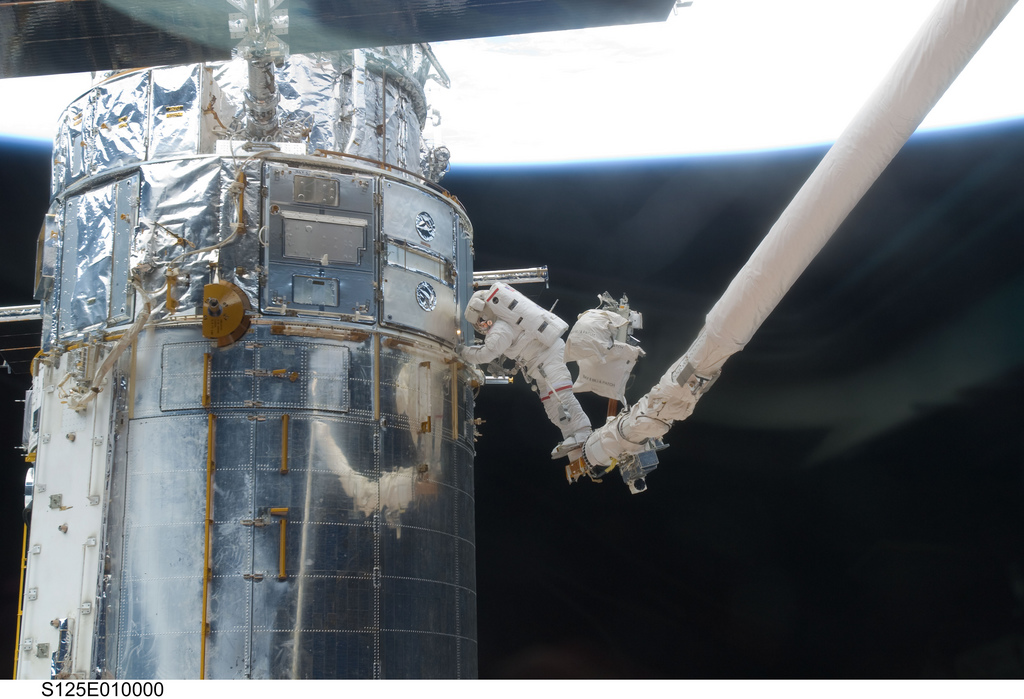
Yesterday I had the pleasure of meeting Astronaut Dr. John Mace Grunsfeld! I was extremely looking forward to this meeting and his lecture. As you know, both Little SDO and I adore Hubble and its science.  If you followed the amazing STS-125 mission to upgrade our dear friend Hubble, then you are familiar with John Grunsfeld, Mike Massimino, Michael Good, Greg Johnson, Scott Altman, Megan McArthuer and Andrew Feustel. The crew of Atlantis repaired and upgraded the Hubble Space Telescope, conducting five spacewalks during that amazing mission to extend the life of the orbiting observatory. If you haven't seen the IMAX or 3D movie, go find a place and take it in!


Astronaut John Grunsfeld STS-125 mission specialist positioned on a foot restraint on the end of Atlantis remote manipulator system RMS, participates in the mission fifth and final session of extravehicular activity.


The other reason why I was looking forward to meeting John is that he flew with Swiss Astronaut Claude Nicollier on STS-103. Claude Nicollier was the very first Astronaut I got to meet and ever since, I have had a very special interest in Space Travel and Switzerland! (plus the chocolate and cheese made me like Switzerland even more!). So getting to meet Mr. Hubble Hugger was a great event for me. Why the nickname Hubble Hugger? Well, John visited Hubble three times and performed many important repair works, making the telescope even better!

In one of my earlier posts I talked about how small this Astro community is. Here is another example. John was part of the NASA Astronaut Group 14, which was nicknamed "The Hogs". Here are some of his class mates:

Scott Horowitz
Scott's first flight was on STS-75 also with Claude Nicollier and Scott's 2nd Flight was also the 2nd Hubble Servicing Mission.

Cady Coleman
I met Cady a couple of months ago at JSC and she is about to launch from Russia next week to join Expedition 26 aboard the International Space Station.

Scott Parazynski
Scott I have now met a couple of times and his stories are plain amazing! Not only has Scott been to Space and done some amazing repair work on the ISS solar panels, but he has also climbed Mt. Everest. And he flew with John Glenn!

Chris Hadfield
I also got to meet the first Canadian Astronaut in Space and the first soon-to-be Canadian ISS Commander. Chris and Scott actually few together on STS-100 to install the robotic arm Canadarm2 to the ISS.

It is enjoyable to see these connections and it just shows me again how important team-work is for these Astronauts and all of us.


Anyway, let's not loose our focus here. John asked a very good question - Why do we study astronomy? And after a few moments he answered his own question with two simple points:

Because it is Fun and Exciting

Because it answers Fundamental Questions
- How did the Universe form
- Where did we come from?
- Are we alone?

It got me thinking of how much we had already discovered before Hubble launched in 1990 and how much Hubble has taught us ever since. Hubble has provided us answers to How the Universe has been formed, given us an idea of where we came from and still let's us dream if we are really alone!

In regards to Hubble, I would make the claim that the Hubble Space Telescope is the most well known telescope there is. We all have seen at least one of its images, read about its successes and issues or heard somebody talk about the challenges with Hubble. Just a couple of weeks ago Little SDO and I introduced this amazing Hubble video


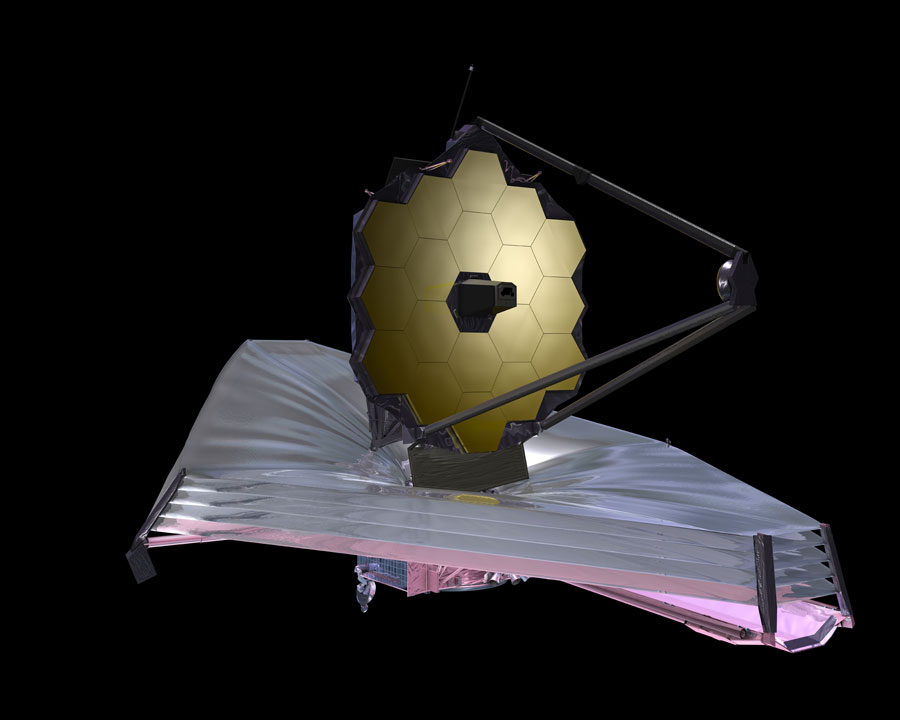
But what's next? John has retired from NASA and is a Deputy Director at the Space Telescope Science Institute in Baltimore. STScI is the home of public outreach activities for Hubble and is also the science and operations center for the James Webb Space Telescope. When JWST launches and gets into position, 1,500,000 km away from Earth, it will become the most powerful scientific tool, looking even further into the Universe and back in time! Will JWST find answers to “Are we alone”? Only time will tell…

The JWST scale model on the lawn at NASA Goddard - takes some creative origami
to get it folded into the Ariane 5 fearing.
As for me, I left yesterday’s meeting with John fulfilled with joy, and amazement. I am thankful to the many people who make all of this possible. From the engineers who design and build these amazing instruments, the people who get them ready to fly, prepare the launch vehicles, guide and train the crews, to the actual heroes who strap themselves to the top of a burning rocket and perform the most dangerous spacewalks and repair works with such grace, it should become an Olympic event! But I am also thankful to the people who show interest, who attend lectures, listen to what scientists and astronauts have to say, who teach in schools, mentor our kids and the leaders of tomorrow and support space travel and exploration!

One final note – we are one blue marble in an endless sea of stars, planets, comets, meteorites and other beautiful things. But we only have this one blue planet and you and I can do so much to keep it blue, to keep it healthy. But we can also influence others, including corporations and Governments to improve processes and procedures, to create laws and to enforce them – we need to take care of mother Earth! Astronaut John Grunsfeld responded to the question of the future of manned space flight:

“It is our destiny to go and explore! Single planet species do not survive!”